Oct 12, 2026Industry Insights
Which Industrial Solvent Is More Volatile? Six Chemicals Compared Using NIST Data
Compare the vapor pressure of THF, methanol, ethyl acetate, acetonitrile, n-heptane and DMF at 30–50°C using published NIST data. Key findings, methodology and limitations.
Research type: published-data analysis. Data source: NIST Chemistry WebBook (SRD 69). Prepared by YUANDAFENG CHEMICAL. Date: October 2026.
Key Findings
Which industrial solvent has the highest vapor pressure under comparable temperature conditions?
To answer this question, we analyzed published vapor-pressure correlations for six commonly used industrial chemicals: tetrahydrofuran (THF), methanol, ethyl acetate, acetonitrile, n-heptane and N,N-dimethylformamide (DMF).
Our calculations produced four key findings:
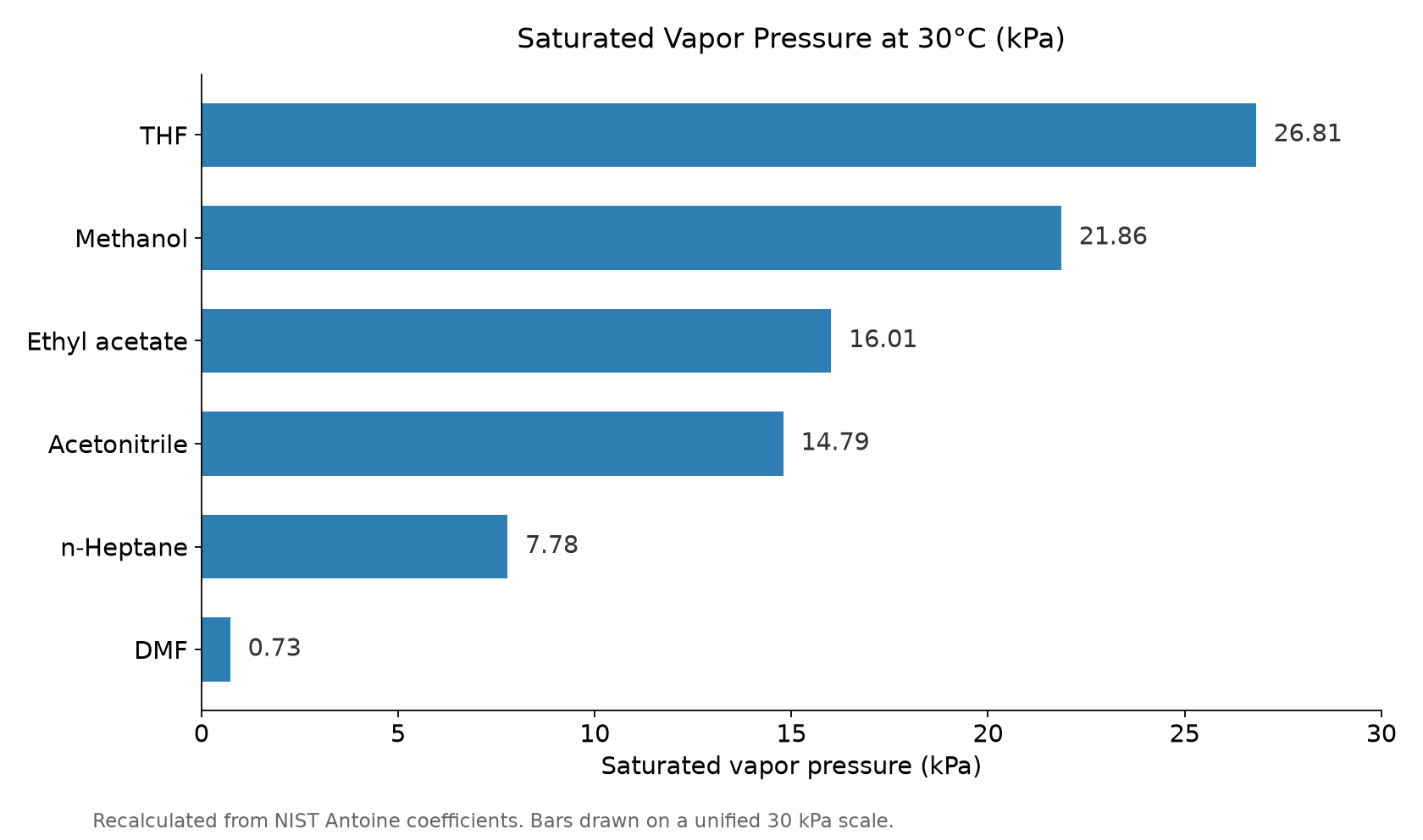
THF had the highest calculated vapor pressure at 30°C, at 26.81 kPa.
DMF had the lowest, at approximately 0.73 kPa.
At 30°C, THF's saturated vapor pressure was approximately 36.7 times that of DMF.
All six substances showed higher vapor pressure at 50°C than at 30°C.
These findings are derived from published experimental-property correlations in the NIST Chemistry WebBook. They are not results of a new laboratory evaporation experiment performed by YUANDAFENG CHEMICAL.
1. Why Solvent Volatility Matters
Volatility is an important consideration when selecting solvents for industrial processing. It can affect solvent handling, vapor generation, drying operations, emissions control and solvent recovery.
However, buyers should distinguish between saturated vapor pressure and actual evaporation rate. Vapor pressure describes an equilibrium property of a substance at a specified temperature. Actual evaporation rate depends on additional operating conditions, including airflow, exposed liquid surface area, vapor concentration and mass transfer.
A solvent with higher vapor pressure is not automatically better for a specific application.
2. The Six Chemicals Compared
The six substances examined, with CAS numbers and chemical families:
Tetrahydrofuran (THF), CAS 109-99-9 — cyclic ether — view product page
Methanol, CAS 67-56-1 — alcohol — view product page
Ethyl acetate, CAS 141-78-6 — ester — view product page
Acetonitrile, CAS 75-05-8 — nitrile — view product page
n-Heptane, CAS 142-82-5 — aliphatic hydrocarbon — view product page
N,N-Dimethylformamide (DMF), CAS 68-12-2 — amide solvent — view product page
These six substances represent different chemical families and are relevant to a range of industrial solvent and chemical-processing applications. To compare them consistently, we calculated saturated vapor pressure at three temperatures: 30°C, 40°C and 50°C.
3. Results: Vapor Pressure Comparison
Table 1. Calculated saturated vapor pressure (kPa): THF 26.81 / 40.22 / 58.60; methanol 21.86 / 35.43 / 55.54; ethyl acetate 16.01 / 25.06 / 37.96; acetonitrile 14.79 / 22.67 / 33.73; n-heptane 7.78 / 12.33 / 18.88; DMF 0.73 / 1.34 / 2.34 (at 30°C, 40°C and 50°C respectively). The same data is visualized in the ranking chart at the top of this page.
Source: Calculations by YUANDAFENG CHEMICAL using Antoine equation parameters published in the NIST Chemistry WebBook. Values rounded to two decimal places.
Which solvent has the highest vapor pressure at 30°C?
Among the six chemicals examined, THF recorded the highest calculated saturated vapor pressure. Methanol ranked second, followed by ethyl acetate and acetonitrile. n-Heptane had a lower calculated value, while DMF showed the lowest value in the group.
At 30°C, the calculated saturated vapor pressure of THF was approximately 36.7 times that of DMF.
This ratio is a vapor-pressure comparison, not a measured evaporation-rate ratio.
How does temperature affect vapor pressure?
All six solvents showed a clear increase in calculated saturated vapor pressure as temperature increased. For example, THF rose from 26.81 kPa at 30°C to 58.60 kPa at 50°C; ethyl acetate from 16.01 to 37.96 kPa; and DMF from 0.73 to 2.34 kPa. Figure 1 plots all six solvents across the selected temperature range.
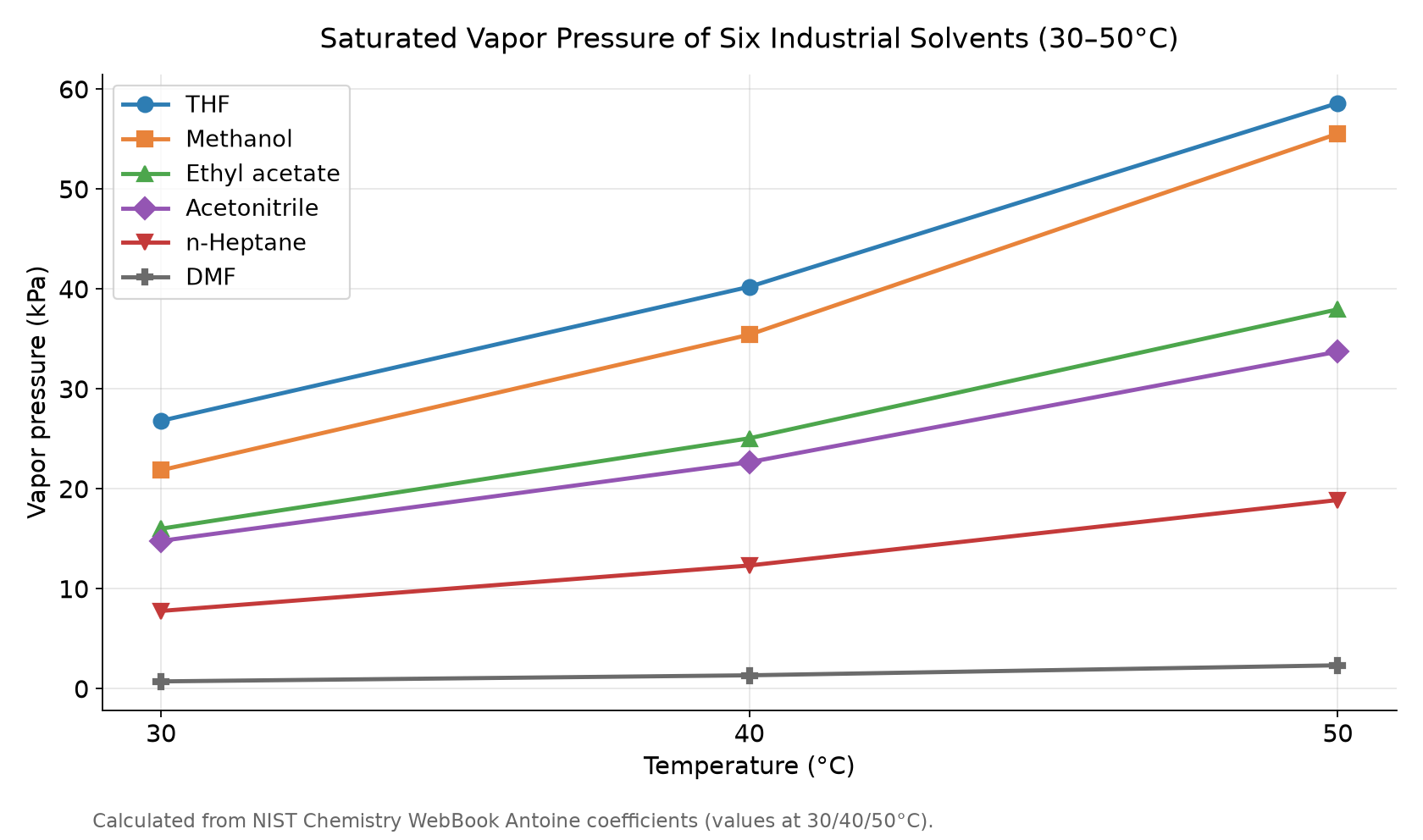
Although DMF's vapor pressure increased considerably in relative terms, its absolute value remained substantially lower than those of THF and ethyl acetate over the selected temperature range. These results demonstrate why temperature must be considered when comparing volatility data.
4. Does Higher Vapor Pressure Mean Faster Drying?
Not necessarily. Higher saturated vapor pressure can indicate a greater tendency to enter the vapor phase under comparable equilibrium conditions, but drying or evaporation in an industrial process involves additional variables.
These include: liquid temperature; airflow over the liquid surface; exposed surface area; vapor concentration in the surrounding atmosphere; solvent composition; and process equipment and operating conditions.
For coating and adhesive formulations, solvent evaporation may also be influenced by resin interactions, film thickness and the presence of other formulation components. Therefore, solvent substitution decisions should not be made using saturated vapor pressure alone.
A controlled evaporation or drying-performance test may be necessary to determine how different solvents behave in a specific industrial formulation.
5. What the Results Mean for Industrial Buyers
Coatings, inks and adhesives
Solvent volatility is one consideration in coating and ink formulation. Buyers should also evaluate resin compatibility, solvency, drying conditions, viscosity and application requirements. A higher-volatility solvent may behave differently during application and film formation, but it is not automatically the most suitable choice.
Industrial cleaning and degreasing
Solvent selection should consider cleaning effectiveness, contaminant compatibility, material compatibility, process temperature and worker-exposure controls. Actual solvent removal after cleaning is affected by operating conditions, not just vapor pressure.
Chemical synthesis and processing
Chemical manufacturers may need to evaluate solvent recovery, reaction conditions, process temperature and residual-solvent requirements. A solvent suitable for one synthesis process may not be appropriate for another.
International chemical procurement
For bulk procurement, physical-property data should be considered alongside commercial specifications. Buyers should verify product identity, grade, purity, impurity limits, packaging and applicable transportation requirements before placing an order.
6. Six Things to Confirm Before Ordering Industrial Solvents
To reduce specification errors and unnecessary quotation revisions, buyers should provide the following information:
Chemical identity: product name and CAS number.
Required grade: purity and application-specific specifications.
Quality documentation: COA, SDS and relevant technical data.
Packaging: required packaging type and net quantity.
Transportation requirements: destination, applicable dangerous-goods requirements and shipping conditions.
Commercial details: order quantity, Incoterms and expected delivery schedule.
A clear inquiry helps the supplier confirm product suitability and prepare a more relevant quotation.
7. Frequently Asked Questions
Which of these six solvents is the most volatile at 30°C?
THF has the highest calculated saturated vapor pressure among the six substances examined, at approximately 26.81 kPa.
Is DMF less volatile than THF?
Yes. Under the temperature conditions analyzed, the calculated saturated vapor pressure of DMF is substantially lower than that of THF. This does not mean that DMF is safer or more suitable for every application.
Can vapor pressure predict actual solvent evaporation rates?
Vapor pressure is an important input, but actual evaporation rates also depend on airflow, liquid surface area, vapor concentration and operating conditions.
Can these results determine whether a chemical is classified as dangerous goods?
No. Transportation classification must be assessed using applicable regulations and chemical-specific information. Vapor pressure alone is not sufficient.
Did YUANDAFENG CHEMICAL conduct these laboratory tests?
No. This article presents an original calculation and comparison based on published vapor-pressure correlations compiled by NIST. No new physical laboratory measurements are claimed.
8. Research Methodology
The analysis uses the Antoine equation published in the NIST Chemistry WebBook: log10(P) = A − B/(T + C), where P is saturated vapor pressure in bar, T is absolute temperature in Kelvin, and A, B and C are empirical coefficients specific to each substance.
Calculations were performed at 303.15 K, 313.15 K and 323.15 K, and the resulting pressure values were converted from bar to kPa. The following NIST coefficients were used:
THF: A = 4.12118, B = 1202.942, C = −46.818
Methanol: A = 5.20409, B = 1581.341, C = −33.500
Ethyl acetate: A = 4.22809, B = 1245.702, C = −55.189
Acetonitrile: A = 4.27873, B = 1355.374, C = −37.853
n-Heptane: A = 4.02832, B = 1268.636, C = −56.199
DMF: A = 3.93068, B = 1337.716, C = −82.648
Each selected correlation covers the three temperatures used in the comparison.
Research limitations
This study compares calculated equilibrium vapor pressures of pure substances. It does not measure industrial drying times, formulation performance, chemical exposure, solvent recovery efficiency or commercial batch quality. The results should not be used as a substitute for product-specific SDS information, applicable transportation regulations or application testing.
9. Conclusion
The NIST-based comparison demonstrates substantial differences in saturated vapor pressure among six commonly used industrial solvents. THF and methanol showed the highest calculated values in the selected group, while DMF showed the lowest.
However, the most volatile solvent is not necessarily the best solvent for a particular industrial application. Reliable solvent selection requires consideration of physical-property data, technical specifications, process requirements, safety information and supplier documentation.
Looking for a reliable industrial solvent supplier?
YUANDAFENG CHEMICAL supports international sourcing of industrial solvents and chemical intermediates, including product specification coordination, quality documentation and export logistics. Tell us your required product, grade, quantity, packaging and destination to discuss an appropriate chemical supply solution.
Request a Quote →
References
NIST Chemistry WebBook — Tetrahydrofuran
NIST Chemistry WebBook — Methanol
NIST Chemistry WebBook — Ethyl Acetate
NIST Chemistry WebBook — Acetonitrile
NIST Chemistry WebBook — n-Heptane
NIST Chemistry WebBook — N,N-Dimethylformamide
Data attribution: NIST Chemistry WebBook, Standard Reference Database 69. This article contains original calculations based on previously published experimental-property correlations.