DMF vs DMAc vs NMP: Which Polar Aprotic Solvent Survives REACH?
DMF, DMAc and NMP are the three polar aprotic solvents buyers compare when a process needs to dissolve something nothing else will — and under REACH, none of them is the "safe" option any more. All three are reproductive toxicants (Repr. 1B, H360D) and ICH Q3C Class 2 residual solvents. DMF and NMP are both on REACH Annex XIV and restricted under Annex XVII (entries 76 and 71); DMAc, the substitute buyers are moving to, gets its own entry 80 from 23 December 2026. Outside the EU, DMF remains widely used, is not a US Clean Air Act hazardous air pollutant, and is TSCA-listed. So the real question is not which solvent is unregulated. It is which restriction your process can live with, and whether your paperwork — the Derived No-Effect Levels in your chemical safety report and safety data sheet — is in order.
Key Findings
- All three are reproductive toxicants and ICH Q3C Class 2 solvents. DMF (PDE 8.8 mg/day, 880 ppm), DMAc (10.9 mg/day, 1,090 ppm) and NMP (5.3 mg/day, 530 ppm) are all "to be limited" in drug products. None of them is the safe choice; the differences are regulatory timing and exposure limits.
- DMF is the most restricted of the three today. It is an SVHC on REACH Annex XIV (authorisation required; the sunset date has passed) and restricted under Annex XVII entry 76 by Regulation (EU) 2021/2030: from 12 December 2023, DMF at 0.3% or more may be placed on the market only if the safety reports and SDS carry the worker DNELs (Table 1).
- NMP is in the same position, and earlier. It is an SVHC on Annex XIV and restricted under Annex XVII entry 71 by Regulation (EU) 2018/588: from 9 May 2020, NMP at 0.3% or more requires the worker DNELs in the CSR and SDS (Table 1). The wire-coating derogation ended on 9 May 2024.
- DMAc is the current substitute — but the window is closing. It is an SVHC candidate, not yet on Annex XIV, which is why buyers are switching to it. But Regulation (EU) 2025/1090 added Annex XVII entry 80 for DMAc: from 23 December 2026, DMAc at 0.3% or more will require the worker DNELs (Table 1). A switch to DMAc buys time, not freedom from restriction.
- Outside the EU the picture is different. DMF remains widely used in the US, China, India, Southeast Asia and the Middle East; it is not a US Clean Air Act hazardous air pollutant and is TSCA-listed. For non-EU buyers the decision is about process fit, price and supply, and the rules of their own market.
Table 1 — DMF vs DMAc vs NMP: key properties
| Property | DMF | DMAc | NMP |
|---|---|---|---|
| Formula | C3H7NO | C4H9NO | C5H9NO |
| CAS No. | 68-12-2 | 127-19-5 | 872-50-4 |
| Molecular weight | 73.09 | 87.12 | 99.13 |
| Boiling point | 153 °C | 165 °C | 202 °C |
| Flash point | 58 °C (closed cup) | 63 °C (closed cup) | 91 °C |
| ICH Q3C | Class 2, PDE 8.8 mg/day, 880 ppm | Class 2, PDE 10.9 mg/day, 1,090 ppm | Class 2, PDE 5.3 mg/day, 530 ppm |
| REACH status | SVHC; Annex XIV; Annex XVII entry 76 | SVHC candidate; Annex XVII entry 80 from 23 Dec 2026 | SVHC; Annex XIV; Annex XVII entry 71 |
| Worker DNELs (REACH) | 6 mg/m³ inhalation; 1.1 mg/kg/day dermal | 13 mg/m³ inhalation; 1.8 mg/kg/day dermal (from 23 Dec 2026) | 14.4 mg/m³ inhalation; 4.8 mg/kg/day dermal |
Sources: ICSC 0457 (DMF); ICSC 0513 (NMP); Fisher Scientific / Wikipedia / Chemsrc SDS data (DMAc); ICH Q3C(R8) Table 2; DNELs from the REACH regulations cited in Methodology.
Table 2 — REACH decision table: your situation, what to do
| Your situation | What to do |
|---|---|
| EU industrial user, DMF in the process | Annex XIV authorisation (or an upstream authorisation) is required — the sunset date has passed. Entry 76 also requires the DNELs in the CSR/SDS (Table 1) and exposure kept below them. Derogations: PU coating of textiles/paper and PU membranes to 12 Dec 2024; dry/wet spinning of synthetic fibres to 12 Dec 2025. |
| EU industrial user, NMP in the process | Annex XIV authorisation plus entry 71 DNELs in the CSR/SDS (values in Table 1), with risk management keeping exposure below them. The wire-coating derogation ended 9 May 2024. |
| EU buyer switching to DMAc as a substitute | It works today, but entry 80 applies from 23 December 2026 (DNELs in Table 1). Plan the changeover and the documentation now — do not assume DMAc stays unrestricted. |
| Pharma buyer, any region | All three are ICH Q3C Class 2. Respect the PDEs in Table 1 and validate the residual-solvent analytical method for the solvent you use. |
| Non-EU buyer (US, China, India, SE Asia, Middle East) | DMF remains widely used; no REACH Annex XIV authorisation applies. Decide on process fit, price and supply, and check your own local rules. |
| Any buyer switching solvents | Bench trial first: solubility, reaction yield, drying time and boiling point, residue, and a revised SDS and label. Never a quiet swap in the warehouse. |
Figure 1 — DMF vs DMAc vs NMP: boiling point
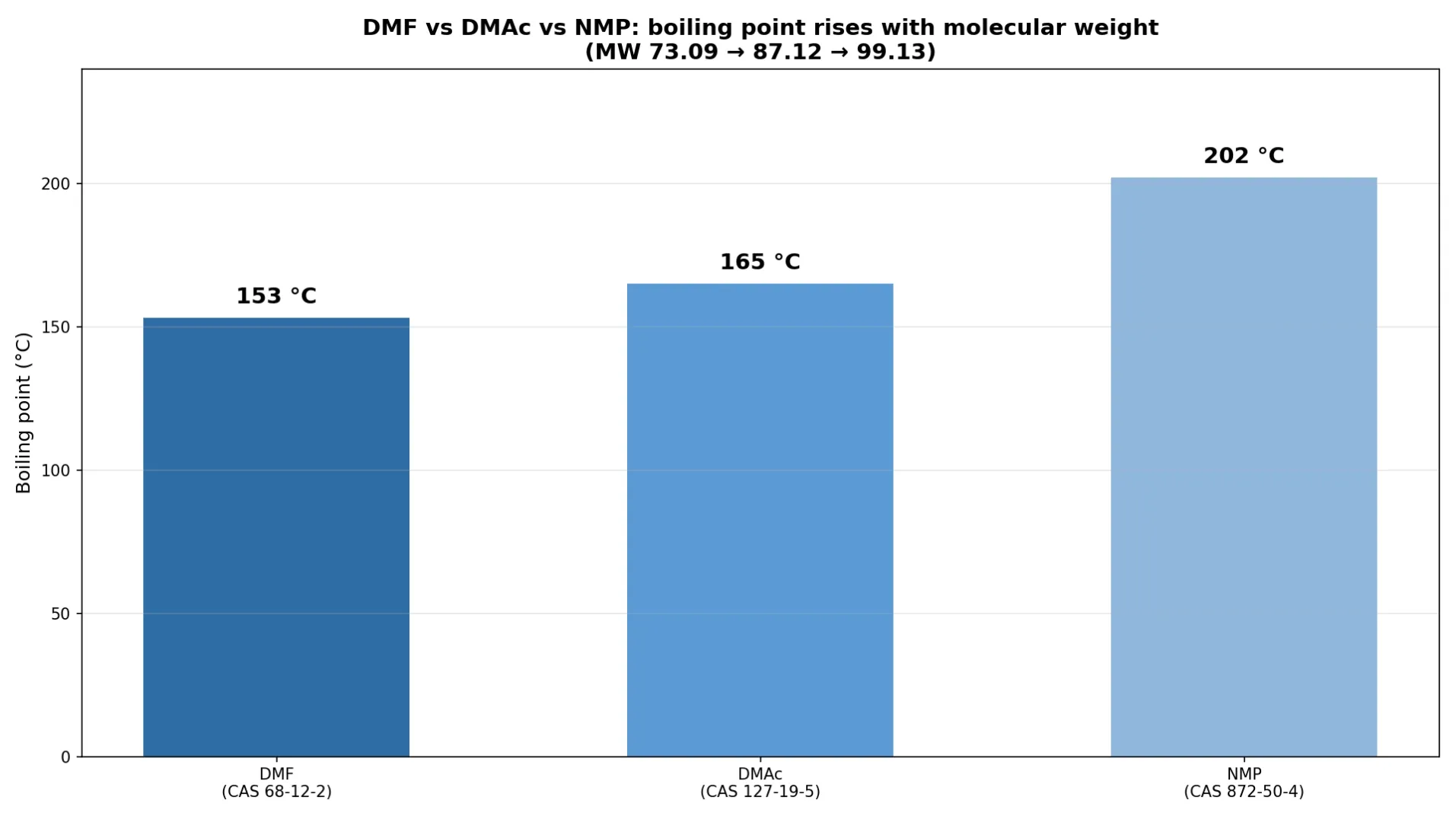
Boiling point rises with molecular weight: DMF 153 °C, DMAc 165 °C, NMP 202 °C.
Why is DMF restricted under REACH?
Because of what it does to reproduction. DMF is classified as toxic to reproduction, category 1B (Repr. 1B, H360D — "may damage fertility or the unborn child"), and on that basis the European Chemicals Agency listed it as a Substance of Very High Concern. That listing put DMF on REACH Annex XIV, the authorisation list: EU manufacturers and importers using DMF in industrial processes must hold a valid REACH authorisation, or operate under an upstream authorisation, and the sunset date has passed. On top of authorisation, Regulation (EU) 2021/2030 of 19 November 2021 added DMF to Annex XVII (entry 76): from 12 December 2023, DMF at 0.3% or more, on its own or in mixtures, may be placed on the market only if the chemical safety reports and safety data sheets include the worker DNELs (Table 1), and manufacture and use must keep worker exposure below those DNELs. None of this is a ban: it is conditional use, and the condition is documented exposure control. But for a buyer it means DMF in the EU is now a compliance project, not a commodity purchase.
What do Annex XIV and Annex XVII mean for a buyer?
They are two different instruments, and DMF is caught by both. Annex XIV is the authorisation list: a substance on it may not be used in the EU after its sunset date unless the user holds an authorisation (or is covered by an upstream one). Annex XVII is the restriction list: it sets conditions under which a substance may be placed on the market or used — in DMF's case, entry 76 conditions continued use at 0.3% and above on the DNELs in the CSR and SDS and exposure below them. The practical consequences for a buyer are threefold. First, the 0.3% threshold catches even DMF as a minor mixture component. Second, documentation is the gate: without the DNELs in the safety report and the extended SDS, the material cannot lawfully be placed on the market at or above 0.3%. Third, exposure control is the ongoing obligation: risk management at the user's site must demonstrably hold exposure below the DNELs. A buyer who cannot show those three things — authorisation, documentation, exposure control — should not be buying DMF for EU use. Note that this is general information about the regulation, not legal advice: always check the current ECHA texts and your safety data sheet.
Is DMAc a drop-in replacement for DMF?
Almost — and that "almost" is where projects fail. DMAc (N,N-dimethylacetamide, CAS 127-19-5) is structurally very similar to DMF: one extra carbon in the acyl group, a boiling point of 165 °C against DMF's 153 °C, a flash point of 63 °C against 58 °C, and closely matched solvency. That is why it is widely adopted as the DMF substitute, including in polyurethane, acrylic fibre and coatings work. But similar is not identical: the higher boiling point changes drying times and energy use; reaction kinetics, solubility of specific polymers, and residue behaviour must be checked by bench trial, not assumed. And DMAc is not a clean escape from regulation either. It is classified Repr. 1B (H360D) like DMF, it is an SVHC candidate, and — critically — Regulation (EU) 2025/1090 added Annex XVII entry 80 for DMAc: from 23 December 2026, DMAc at 0.3% or more will require the worker DNELs in the CSR and SDS (Table 1), with exposure kept below them. Its oral LD50 in rats (4,300 mg/kg) is higher than DMF's, but acute toxicity was never the reason for the restrictions — reproductive toxicity was. So: DMAc buys time and removes the Annex XIV authorisation problem for now, but any buyer switching to it should plan as if the restriction is already in force, because in a matter of weeks it will be.
What about NMP — is it any better?
No — it is in the same position as DMF, and it got there first. NMP (N-methyl-2-pyrrolidone, CAS 872-50-4) is also an SVHC (Repr. 1B, H360D) on Annex XIV, and it has been restricted under Annex XVII entry 71 since 9 May 2020 by Regulation (EU) 2018/588, on the same model as DMF: at 0.3% or more, the CSR and SDS must carry the worker DNELs (Table 1), and exposure must stay below them. The derogation for use as a solvent or reactant in coating wires expired on 9 May 2024. Where NMP does differ is in the process: its boiling point (202 °C) is far higher than DMF's (153 °C), so it suits high-temperature work, lithium-battery electrode processing and paint stripping — but the higher boiling point also means slower drying and higher energy to remove it. For pharma buyers NMP is the tightest of the three under ICH Q3C (PDE 5.3 mg/day, against 8.8 for DMF and 10.9 for DMAc). In the US, the EPA published a proposed risk-management rule for NMP under TSCA Section 6(a) in June 2024, so American buyers should watch that docket too. Switching from DMF to NMP to escape REACH solves nothing: it trades one Annex XIV substance for another, with an earlier restriction date.
How do I choose — and what does Yuandafeng supply?
Choose by market first, process second. If your use is in the EU, the regulation decides: DMF and NMP both need authorisation plus DNEL documentation; DMAc needs the documentation from 23 December 2026 and avoids authorisation for now — but confirm the current status with your regulatory team before committing. If your use is outside the EU, DMF remains widely used and the choice turns on process fit: DMF's lower boiling point (153 °C) dries faster and costs less energy to remove; DMAc (165 °C) is the closest substitute with the least revalidation; NMP (202 °C) is for high-temperature work where the others are too volatile. For pharma, the ICH Q3C PDEs rank the three the other way round from their boiling points (see Table 1). Whatever you choose, run a bench trial — solubility, yield, drying, residue — and revise the SDS and label before the first production batch.
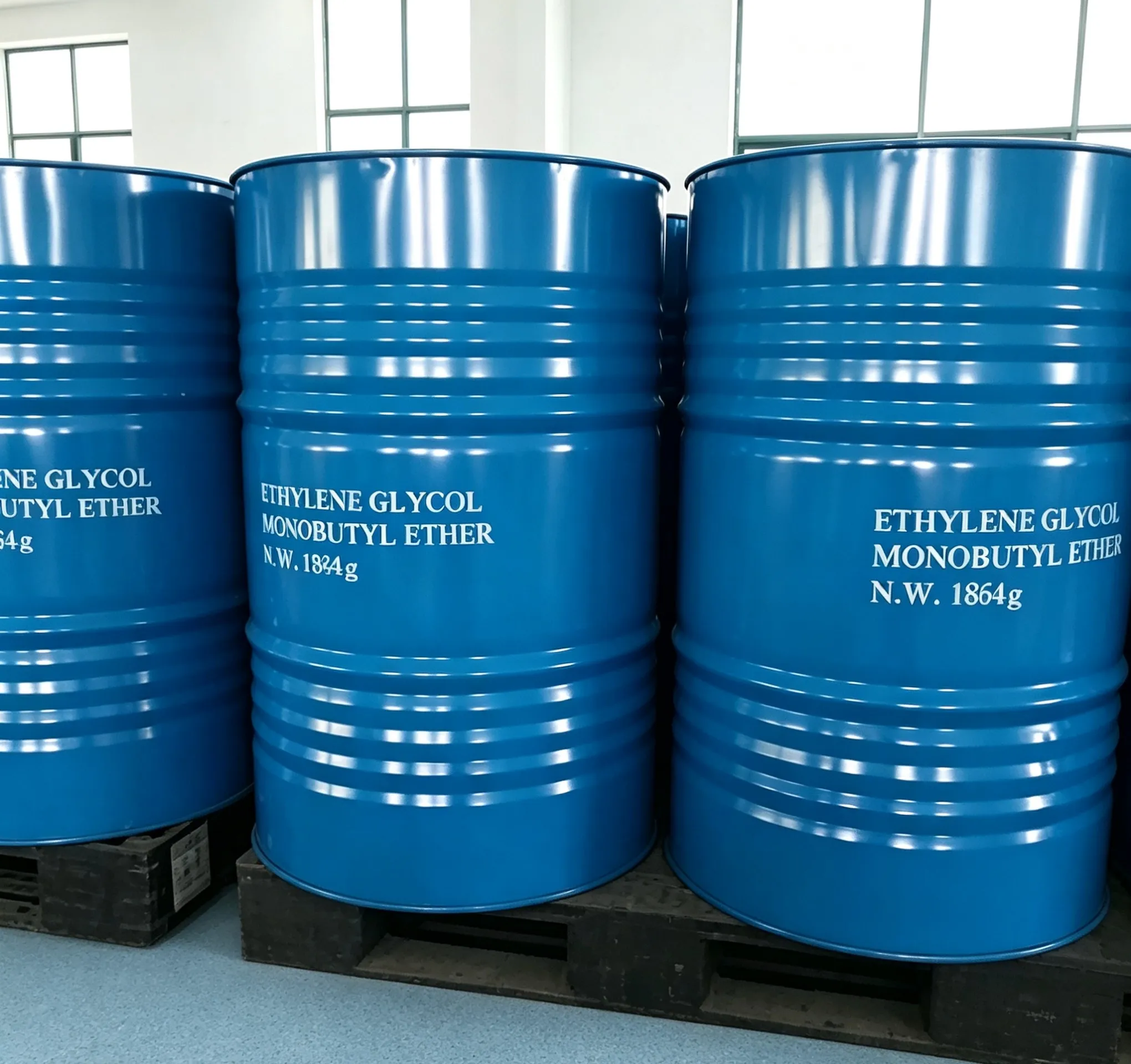
What Yuandafeng supplies: Yuandafeng's listed polar aprotic solvent is DMF — N,N-dimethylformamide 99.9% (CAS 68-12-2), in 200 kg drums, with per-batch COA, SDS and TDS available on request. If you need DMAc or NMP, ask us for availability. Yuandafeng is a licensed hazardous-chemical exporter, not a manufacturer. For a quotation, send the product name or CAS number, specification, quantity, packaging and destination port.
View DMF product specifications
FAQ
Is DMF banned in the EU?
No. DMF is not banned; it is restricted and subject to authorisation. EU industrial use requires a REACH authorisation (or upstream authorisation), and from 12 December 2023, DMF at 0.3% or more requires the worker DNELs in the chemical safety report and SDS (values in Table 1), with exposure kept below them.
Can I still buy DMF for use outside the EU?
Yes. DMF remains widely used in the US, China, India, Southeast Asia and the Middle East. It is not a hazardous air pollutant under the US Clean Air Act and is TSCA-listed.
Is DMAc safe?
No. DMAc is classified Repr. 1B (H360D), is an SVHC candidate, and from 23 December 2026 Annex XVII entry 80 will require the worker DNELs (Table 1) at 0.3% and above. "Less restricted than DMF today" is not the same as safe.
If I switch from DMF to DMAc, do I need to change my SDS?
Yes. A different substance means a new SDS, new DNELs, new exposure scenarios and revised labelling — and, in the EU, the entry 80 conditions from 23 December 2026. Have your safety team review the change before the first production batch.
What is the ICH Q3C limit if my drug product uses DMF?
DMF is an ICH Q3C Class 2 residual solvent: permitted daily exposure 8.8 mg/day, concentration limit 880 ppm (Option 1, assuming a 10 g daily dose). DMAc is 10.9 mg/day / 1,090 ppm and NMP is 5.3 mg/day / 530 ppm.
Methodology
Property data are from ICSC 0457 (DMF, April 2014) and ICSC 0513 (NMP), and from Fisher Scientific, Wikipedia and Chemsrc SDS data for DMAc (boiling point 165–166 °C, flash point 63 °C closed cup). ICH Q3C Class 2 PDEs are from ICH Q3C(R8) Table 2 as reproduced in the Assyro residual-solvents guide. REACH facts are from Regulation (EU) 2021/2030 (DMF, Annex XVII entry 76), Regulation (EU) 2018/588 (NMP, Annex XVII entry 71, text via legislation.gov.uk), and Regulation (EU) 2025/1090 (DMAc entry 80, as reported by Astrobio). The DMF Annex XIV/SVHC status and the non-EU position are as stated on the Sinolook DMF page. This article is general information about regulation, not legal advice.
Limitations
- The DMAc ICSC number could not be verified (ICSC 0266 is ethane), so no ICSC number is given for DMAc in this article.
- NMP's boiling point is 202 °C per ICSC 0513; some supplier SDS list 204 °C. DMAc's flash point is 63 °C closed cup in the most-cited SDS data, with 64–70 °C in some sources depending on the test method.
- DMF packaging is stated as 200 kg drums, per the product specification table; confirm the packaging for your order when requesting a quotation.
- REACH dates and DNELs are as in force at writing (November 2026). Regulation (EU) 2025/1090 (DMAc entry 80) applies from 23 December 2026 — verify the current ECHA entry before relying on it. Check the current ECHA texts and your SDS.
- No MOQ, lead time, price or certificate is stated in this article; all are confirmed in the quotation.
References
- ICSC 0457 — N,N-Dimethylformamide (ILO/IPCS, April 2014): https://inchem.org/documents/icsc/icsc/eics0457.htm
- Sinolook — Dimethylformamide (DMF): REACH Annex XIV, DMF vs DMAc vs NMP comparison: https://www.sinolookchem.com/coatings-and-inks/chemical-for-coating/dimethylformamide-dmf.html
- Astrobio — DMF Alternative: REACH Annex XVII entry 76, Regulation (EU) 2021/2030: https://www.astrobiosolvent.com/solventi/dmf-dimethylformamide-68-12-2/
- Commission Regulation (EU) 2018/588 — NMP, REACH Annex XVII entry 71 (legislation.gov.uk): https://www.legislation.gov.uk/eur/2018/588/2020-01-31/data.html
- Astrobio — NEP Alternative: Regulation (EU) 2025/1090, Annex XVII entries 80 (DMAc) and 81 (NEP): https://www.astrobiosolvent.com/solventi/nep-ethyl-pyrrolidone-2687-91-4/
- Assyro — ICH Q3C Residual Solvents: Limits Guide (Class 2 PDEs: DMF 8.8, DMAc 10.9, NMP 5.3 mg/day): https://www.assyro.com/blog/residual-solvents-ich-q3c-guide