How to Verify a Chemical Supplier in China: COA, SGS, and the Trial Order
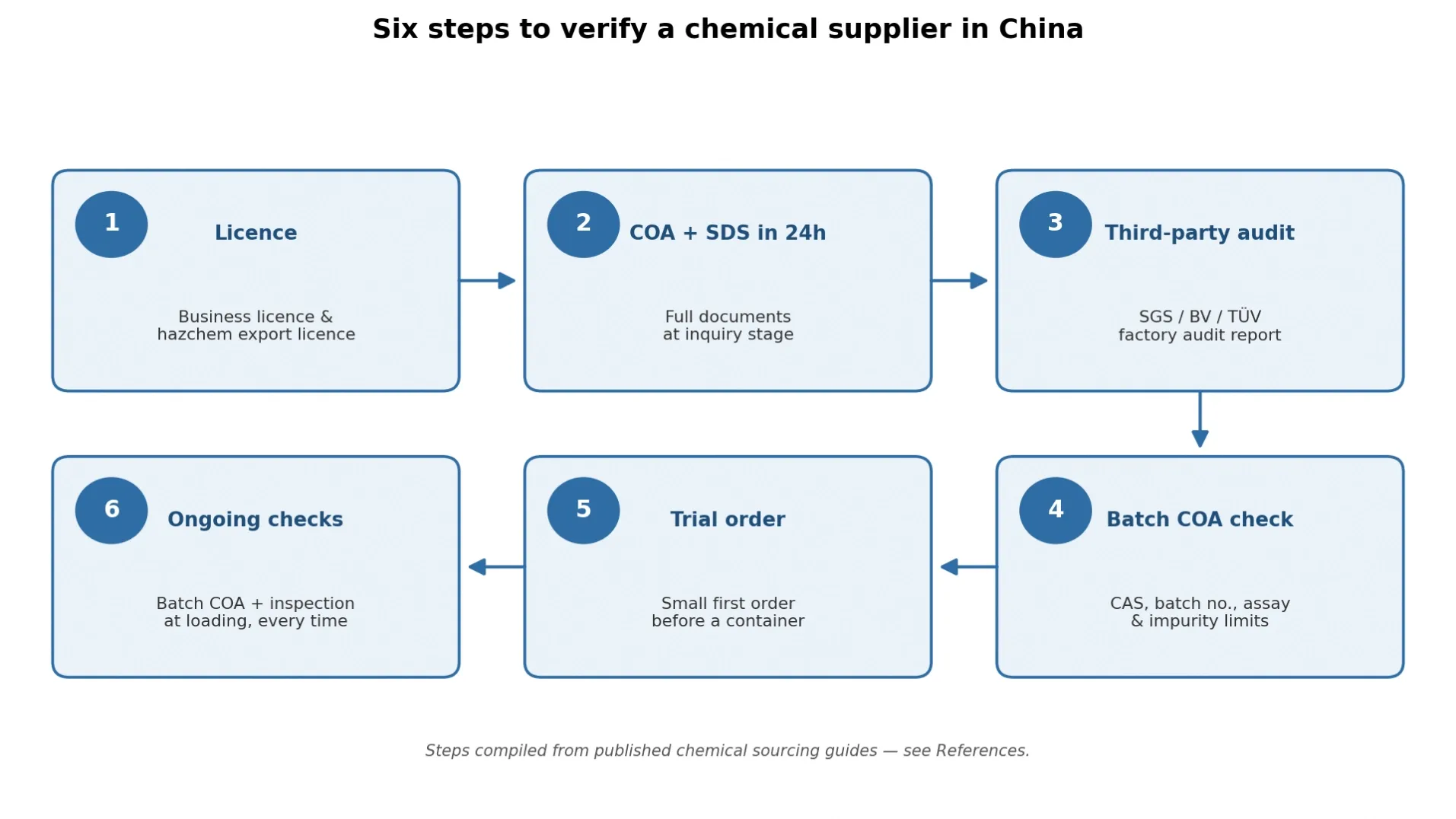
Verifying a chemical supplier in China is a sequence of checks, not a single document. Start with the business licence — free to check in about fifteen minutes on China's official registry — then ask for the COA and SDS at the inquiry stage: a serious supplier produces both within 24 hours.
Next, look for a third-party factory audit (SGS, Bureau Veritas or TÜV), read the per-batch COA line by line, and start with a small trial order before committing to a container. For high-value or first orders, commission an independent inspection at loading, with the report sent directly to you. This guide explains each step, what good evidence looks like, and which red flags mean you should walk away.
Key Findings
- Verification is a sequence, not a single certificate. Licence → documents within 24 hours → third-party audit → batch COA check → trial order → ongoing checks on every shipment. Skipping a step is how a bad batch gets through.
- The COA is the core document. It must be per batch, and it must list the CAS number, batch number, physical constants, assay and impurity results — and all three must match: the quotation, the COA, and the drum label.
- A supplier's own COA is a starting point, not a conclusion. Independent inspection at loading (SGS, BV or Intertek), with the sample taken at the point of bagging or loading and the report sent directly to you, is the check a COA cannot replace.
- A trading company is not automatically riskier than a manufacturer. The risk is undocumented supply. A trader that provides a per-batch COA, SGS/BV inspection and trial orders is verifiable; a factory that provides none of these is not.
- Start small. If a supplier cannot produce a COA and SDS within 24 hours at the inquiry stage, expect longer delays during the real order — or worse. A trial order is the cheapest possible audit.
Supplier verification checklist
Table 1 — Supplier verification checklist
| Check | Evidence to request | What a good answer looks like |
|---|---|---|
| Business licence & export permits | Copy of the business licence (营业执照); hazardous-chemical export licence | Verifiable on China's National Enterprise Credit Information Publicity System (gsxt.gov.cn) by the 18-digit Unified Social Credit Code; licence scope covers chemical export |
| Quality management | ISO 9001:2015 certificate | Certificate number and scope covering the products you buy; validity confirmed |
| Third-party factory audit | SGS, BV or TÜV audit report | A recent report covering the product category; if you commission a factory visit, the published guide cost is roughly $300–800 |
| Documents at inquiry stage | COA and MSDS/SDS | Full documents within 24 hours; batch-specific, not a generic sample sheet |
| Batch COA | Per-batch COA | CAS number, batch number, physical constants, assay and impurity results; matches the quotation |
| Third-party inspection | SGS, BV or Intertek pre-shipment inspection | Inspection and sampling at loading; report sent directly to you, not via the supplier |
| Export history | Trade data (ImportGenius, Panjiva) | Real shipping volumes and destination markets matching the supplier's claims |
| Trial order | Small first order | Supplier accepts a trial order before a full container |
Sources: XinsenYao sourcing guide; Topfine supplier guide; Jumingchem supplier-audit guide; HI-COM NECIPS guide.
Documents per shipment: standard vs on request
Table 2 — Documents per shipment: standard vs on request
| Document | Standard with every shipment | On request |
|---|---|---|
| Certificate of Analysis (COA), per batch | Yes | — |
| Safety Data Sheet (SDS / MSDS) | Yes | — |
| Technical Data Sheet (TDS) | — | Yes |
| Commercial invoice | Yes | — |
| Packing list | Yes | — |
| Bill of lading | Yes | — |
| Certificate of origin | — | Yes |
| Third-party inspection report (SGS / BV) | — | Yes |
| REACH / SVHC declarations | — | Yes |
Per published supplier guides, every shipment should include a batch-specific COA, MSDS, commercial invoice, packing list and bill of lading; certificates of origin, REACH/SVHC declarations and third-party inspection reports are arranged on request.
What documents must a supplier produce before I pay?
Before any payment, ask for four things. First, a copy of the business licence (营业执照) — then verify it yourself on China's National Enterprise Credit Information Publicity System at gsxt.gov.cn, the official registry run by the State Administration for Market Regulation. Search by the 18-digit Unified Social Credit Code (统一社会信用代码) on the licence; it is the most accurate method, since the English name a supplier uses in sales material rarely matches the registered legal name.
Check that the registered name, legal representative, address, business scope and status match the licence copy — the status should read 存续 or 在业 (active). Also check the tabs for administrative penalties and abnormal-operation records.
Second, the hazardous-chemical export licence or equivalent export permit — a licence proves the company legally exists, not that it may export chemicals, so confirm the scope. Third, the COA and SDS for the product you are buying, within 24 hours of your inquiry. Fourth, for a first or large order, the third-party factory audit report (SGS, BV or TÜV).
A supplier that produces all four without hesitation is behaving like a real exporter; one that stalls on the first two is not.
How do I read a COA?
A certificate of analysis is only useful if you read all of it. Start with identity: the CAS number and the product name must match your quotation exactly — a mismatch is an immediate disqualifier.
Next, the batch number and test date: the COA must belong to the batch you are buying, not a "typical" example from another lot. Then the assay and the impurity results: for ethylene glycol, that means the EG content by GC, water by Karl Fischer, DEG content, iron, chloride, acidity, aldehydes, colour and UV transmittance, each against the agreed specification.
A useful COA also lists the test method for each item, so you can see whether the numbers were actually measured. Compare the physical constants — density, boiling point, flash point — with the published datasheet values; they should match within normal measurement tolerance.
Finally, ask for COAs from at least three consecutive batches, not just one: a single good COA proves one batch, and consistency across batches is what you are actually buying. If any line is missing, out of specification, or copied from a generic template, raise it in writing before paying.
What does an SGS or BV inspection actually check?
A third-party inspection is the independent check that a supplier's own paperwork cannot provide. There are two kinds, and buyers confuse them. A factory audit — the SGS factory audit report, for example — checks the supplier's quality system, facilities and processes, and is usually a one-off or periodic report.
A pre-shipment inspection checks your actual goods: the inspection body visits at loading, verifies quantity and packaging, takes samples at the point of bagging or loading (not from a retained reference sample in the supplier's office), and tests them in a laboratory. Insist on sealed and numbered sample bags with photos of the bagging process, and specify exactly which tests the laboratory should run — for a solvent, typically the assay and the key impurities from the agreed specification.
Crucially, the inspection report must be sent directly to you by the inspection body. If the supplier resists independent sampling, or insists on shipping the sample themselves, that resistance is itself information. The cost of a factory visit is roughly $300–800 according to published sourcing guides; pre-shipment inspection fees depend on the port, the scope and the inspection body, so confirm them with SGS or BV directly before ordering.
Is a trading company riskier than a manufacturer?
Not necessarily — and for many buyers, the question is the wrong one. A business licence proves a company legally exists; it does not prove the company owns a factory, has export rights, or makes good products. What matters is whether the supply is documented and checkable.
Yuandafeng Chemical is a trading company, and says so plainly: it does not own a factory, so a factory audit applies to its partner producers, not to Yuandafeng itself. What a buyer verifies from a trading company is the documentation chain — a per-batch COA from the producer, SGS or BV inspection at loading, a three-step quality check before dispatch, and the right to start with a trial order.
A trader also does work a single factory cannot: consolidating mixed loads (FCL/LCL), holding export documentation for several products, and managing dangerous-goods shipping across suppliers. The risk to avoid is undocumented supply — a seller of either kind that cannot produce a licence, a batch COA, or an inspection report. Judge the paperwork, not the business model.
What are the red flags — and what does Yuandafeng provide?
Walk away, or reduce your exposure sharply, when a supplier: cannot produce a COA or SDS within 24 hours at the inquiry stage; sends a COA with no batch number, no test date, or only an assay line; refuses a trial order or independent sampling at loading; quotes a price far below every other supplier with no explanation; or pressures you to pay in full before producing any document.
A mismatch between the licence and the registry record — a different legal name, a revoked status, or a business scope that does not cover chemicals — is a stop, not a warning.
What Yuandafeng provides: Yuandafeng Chemical is a licensed hazardous-chemical exporter. Every order is supplied with a per-batch COA, and SDS and TDS are available on request. A three-step quality check is applied before dispatch, and SGS or BV third-party inspection is available.
Orders ship FCL or LCL, and trial orders are supported. Yuandafeng serves the pharmaceutical, agrochemical, coatings, ink and electronics industries.
No ISO certificate, production licence or specific audit report number is claimed for Yuandafeng in this article, because none has been confirmed — ask for the current documents when you send your inquiry, and check them the same way this guide describes.
View Ethylene Glycol product specifications
FAQ
What if the supplier's COA and the third-party test disagree?
Trust the independent test. Stop the shipment, ask the supplier for an explanation in writing, and do not accept the batch until the discrepancy is resolved — either by re-testing a fresh sample or by replacing the goods.
Can I verify a supplier without visiting China?
Yes, for most purposes. The licence check on gsxt.gov.cn is free and takes about fifteen minutes; documents, third-party inspection and trade data can all be handled remotely. A factory visit — roughly $300–800 according to published guides — is the single best investment before a large first order, but it is not the only check.
Is ISO 9001 enough on its own?
No. ISO 9001:2015 is a quality-management baseline: it says the supplier has a documented system, not that a particular batch meets your specification. You still need the batch COA, and for a first order, an independent inspection.
How much does third-party inspection cost?
A factory visit costs roughly $300–800 according to published sourcing guides. Pre-shipment inspection fees vary by port, scope and inspection body — confirm the price with SGS, BV or Intertek before ordering rather than relying on a quoted figure.
What should I do if the supplier refuses a trial order or independent sampling?
Treat the refusal as information. A serious supplier provides documents and access without hesitation. Either walk away, or reduce the order to a size you can afford to lose and insist on inspection before any larger commitment.
Methodology
The verification steps in this article are compiled from published chemical sourcing and supplier-audit guides: the XinsenYao complete buyer's guide for sourcing industrial chemicals from China (2026), the Topfine guide to choosing a chemical supplier, the Jumingchem supplier-audit and purity/compliance guides, a supplier-evaluation guide on third-party sampling and testing, and the HI-COM guide to China's National Enterprise Credit Information Publicity System.
Claims about Yuandafeng are limited to facts stated on the company's own website: licensed hazardous-chemical exporter, per-batch COA, SGS/BV inspection available, three-step QC, FCL/LCL and trial orders, and the industries served. No MOQ, lead time or price is stated, because none is published for these products.
Limitations
The sourcing guides cited are written by chemical suppliers themselves, not by independent regulators, so their checklists reflect commercial practice rather than a legal standard — cross-check the key steps against the official registry (gsxt.gov.cn) and the inspection bodies (SGS, BV, Intertek) directly. The $300–800 factory-visit figure is a typical range from one published guide, not a quotation.
Pre-shipment inspection fees, certificate-of-origin procedures and REACH documentation requirements vary by product, destination and inspection body. This article does not claim any ISO certificate, production licence or audit report number for Yuandafeng, and it does not replace legal advice on import compliance in your own country.
References
- XinsenYao — How to Source Industrial Chemicals from China: A Complete Buyer's Guide (2026): https://www.xinsenyaochem.com/blog-2026-07-20-how-to-source-chemicals-from-china.html
- Topfine Chemical — How to Choose a Chemical Supplier?: https://www.topfinechem.com/search
- Jumingchem — Electronic-Grade Chemicals Supplier Audit: COA, Purity and Certifications: https://blog.jmchemchina.com/blog/Electronic-Grade-Chemicals-Supplier-Audit:-COA,-Purity-and-Certifications.html
- Jumingchem — Electronic-Grade Chemicals: Purity, Parameters & Compliance — A Buyer's Guide: https://blog.jmchemchina.com/blog/Electronic-Grade-Chemicals:-Purity,-Parameters-and-Compliance-A-Buyers-Guide.html
- Silica Fume Supplier — How to Evaluate the Quality of a Silica Fume Supplier Without Visiting the Factory?: https://www.silicafumesupplier.com/how-to-evaluate-the-quality-of-a-silica-fume-supplier-without-visiting-the-factory.html
- HI-COM — NECIPS China Company Verification Guide (National Enterprise Credit Information Publicity System, gsxt.gov.cn): https://www.hicom-asia.com/how-to-check-chinese-company-necips/