THF Peroxide Safety: How to Store, Test, and When to Dispose
Tetrahydrofuran (THF) is one of the few common solvents that can turn dangerous simply by sitting on a shelf. Exposed to air, it reacts with oxygen in a free-radical chain reaction called autoxidation and forms explosive peroxides — mainly 2-hydroperoxytetrahydrofuran. Unstabilised THF can exceed 1 wt% peroxide within 2–4 weeks at room temperature. Peroxide levels are read in bands: below 25 ppm is generally safe, 25–50 ppm is moderate, 50–100 ppm is high, and above 100 ppm is hazardous. The protection is simple but not optional: buy stabilised THF unless your method forbids it, keep containers tightly sealed, cool and dark, date them on receipt and on opening, test opened containers every 3 months, and dispose of any THF you cannot verify — never distil it. This guide covers the chemistry, the storage rules, the tests, and the disposal decisions, so a drum of THF stays a solvent and never becomes a hazard.
Key Findings
- THF makes its own hazard. Autoxidation with atmospheric oxygen produces explosive peroxides (mainly 2-hydroperoxytetrahydrofuran); unstabilised THF can exceed 1 wt% peroxide within 2–4 weeks under ambient conditions.
- BHT stabiliser helps but is not permanent. Butylated hydroxytoluene (BHT), typically 250–400 ppm, scavenges the free radicals that start peroxide formation — but it is consumed over time, especially after the container is opened, so stabilised THF still needs testing.
- Shelf life is a range, not a date. Manufacturer guidance varies: unopened containers 12–24 months, opened containers 3–6 months. Date every container on receipt and again on opening, and follow the expiry date on your batch SDS.
- Peroxide level is read in bands. Below 25 ppm is generally safe, 25–50 ppm is moderate, 50–100 ppm is high, and above 100 ppm is hazardous. THF above 0.1 wt% peroxide must not be distilled or heated above 60 °C without peroxide removal first — and THF must never be distilled to dryness.
- Testing is simple and cheap. Commercial peroxide test strips give a semi-quantitative reading in minutes; the potassium iodide (KI) test gives a colour scale (colourless <10 ppm, pale yellow 10–50 ppm, brown >50 ppm). Test opened containers every 3 months, and always test before distilling or evaporating.
Table 1 — THF shelf life: typical manufacturer guidance ranges
| Condition | Typical guidance | Notes |
|---|---|---|
| Unopened container | 12–24 months | From date of manufacture; some sources give 12 months, others 24, one 30 — always check the expiry date on your batch SDS/COA |
| Opened container | 3–6 months | Use as soon as possible after opening; date the container on opening |
| Test opened containers | Every 3 months | Also test before distilling or evaporating, and if the THF has been stored for more than 12 months |
| Storage temperature | Cool, below 37 °C | Dry, well-ventilated area, away from heat sources, sparks and open flames |
| Container and atmosphere | Original tightly sealed container, protected from light | Ideally stored under a nitrogen or argon blanket to limit oxygen contact |
Sources: BenchChem BHT-stabilised THF safety guide and THF disposal guide; BenchChem THF shelf-life data. Ranges differ between manufacturers — the binding date is the one on your batch documents.
Table 2 — Peroxide test methods
| Method | What it shows | When to use it | Limits |
|---|---|---|---|
| Commercial peroxide test strips | Semi-quantitative peroxide level | Routine checks — the most convenient method | Semi-quantitative only; follow the strip manufacturer’s instructions and expiry |
| Potassium iodide (KI) test | Colour scale: colourless <10 ppm, pale yellow 10–50 ppm, brown >50 ppm | Quick laboratory check: add THF to glacial acetic acid, then a few drops of freshly prepared 5–10% aqueous KI solution | Qualitative/semi-quantitative; needs freshly prepared KI solution |
| Iodometric titration | Quantitative peroxide content (detection limit ~0.005 wt%) | When an exact number is needed — e.g. before distillation, or before a disposal decision | A laboratory method; takes more time and equipment |
Figure 1 — THF shelf life: typical manufacturer guidance ranges
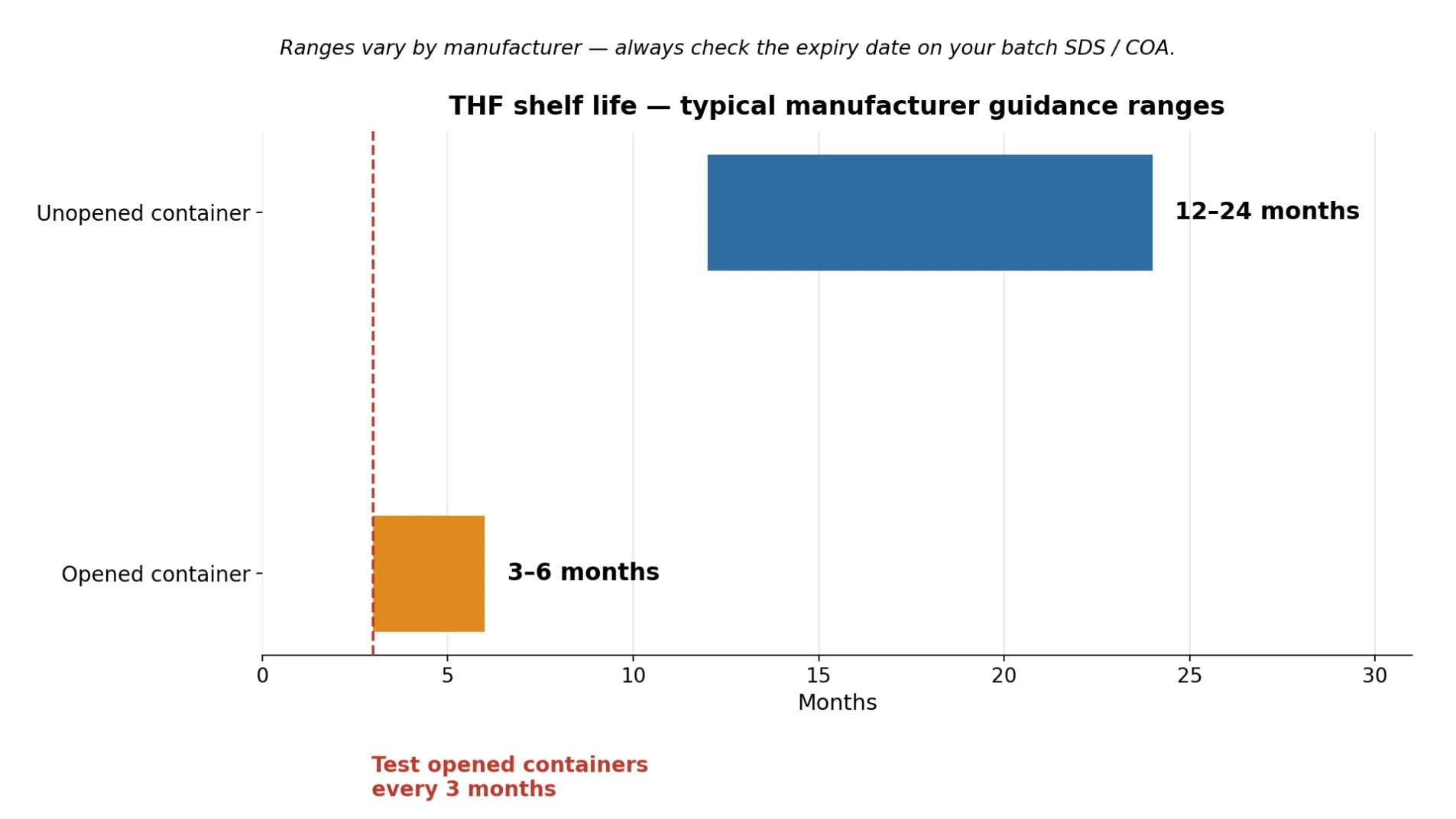
Unopened 12–24 months; opened 3–6 months; test opened containers every 3 months. Ranges vary by manufacturer — check the expiry date on your batch SDS/COA. Sources: BenchChem BHT-stabilised THF safety guide; BenchChem THF disposal guide.
Why does THF form peroxides?
THF reacts with atmospheric oxygen in a free-radical chain reaction known as autoxidation. Oxygen attacks the carbon next to the ring oxygen, and the primary product is 2-hydroperoxytetrahydrofuran, which can go on to form polymeric peroxides. The reaction is catalysed by light, heat and contaminants, and it runs faster in a partly empty, clear container with a large headspace of air. That is why the hazard grows with storage time rather than with use: freshly distilled THF typically contains only 0.01–0.05 wt% peroxide, but the same material left standing for 2–4 weeks under ambient conditions (20–25 °C, atmospheric oxygen) can exceed 1.0 wt%. The peroxides themselves are the danger — they are shock-sensitive and can decompose explosively when heated, subjected to friction or mechanical shock. The worst case is distillation: peroxides are less volatile than THF, so they concentrate in the still pot, and distilling THF to dryness can leave behind a residue of nearly pure explosive peroxide. This is why the first rule of THF safety is never to distil it to dryness, and never to distil or heat above 60 °C any THF that tests above 0.1 wt% peroxide without removing the peroxides first. ICSC 0578 states the hazard plainly: "The substance can form explosive peroxides."
Stabilised vs unstabilised THF: which should I buy?
Most commercial THF is supplied stabilised, most often with butylated hydroxytoluene (BHT), typically at 250–400 ppm (some sources give 100–400 ppm). BHT is a phenolic antioxidant and free-radical scavenger: it donates a hydrogen atom to the peroxy radicals formed in the first steps of autoxidation, terminating the chain reaction before peroxides can accumulate. It extends shelf life and makes storage far safer — but it is consumed as it works, and its concentration falls over time, especially in opened containers exposed to air and light. Stabilised THF therefore still forms peroxides eventually, and still needs the 3-month testing routine.
There is one real reason to buy unstabilised THF: BHT absorbs UV light, strongly around 275–280 nm, and that absorbance can interfere with HPLC UV detection at low wavelengths, causing baseline noise and drift. For sensitive low-UV HPLC work, unstabilised THF is preferred — but it must be bought in small quantities, used quickly after opening, and tested frequently, because without a stabiliser peroxides can form within days of exposure to air.
Which should you buy? Stabilised, unless your method specifically forbids the stabiliser. And whichever you buy, confirm the stabilisation status and the shelf life on the COA and SDS for your batch — do not assume. (Note: whether Yuandafeng’s THF is BHT-stabilised is not confirmed in the sources used for this article; confirm it on the batch COA/SDS when you order.)
How do I store THF?
Store THF in its original, tightly sealed, air-impermeable container, in a cool (below 37 °C), dry, well-ventilated area, away from heat sources, sparks and open flames, and protected from light — opaque or amber containers, or a dark store. Where practical, keep the container under a nitrogen or argon blanket, which limits oxygen contact and extends shelf life beyond 12 months without significant peroxide accumulation. Keep THF away from strong oxidants, strong bases and some metal halides, which ICSC 0578 lists as violent-reaction hazards, and note that THF attacks some plastics, rubbers and coatings — use compatible seals and gaskets. Do not use compressed air for filling, discharging or handling (ICSC 0578). Date every container on receipt and again on opening, and keep a simple log: receipt date, opening date, test dates and results. A drum that cannot be dated cannot be trusted — if the opening date is unknown, test before use, and treat an undated opened container as suspect.
How do I test for peroxides?
Test opened containers every 3 months, before distilling or evaporating, before use if the container has been opened for more than 3 months, and if the THF has been stored for more than 12 months. The most convenient method is commercial peroxide test strips, which give a semi-quantitative reading in minutes — dip, wait, and compare with the colour chart. The classic laboratory method is the potassium iodide (KI) test: add about 1 mL of the THF to 1 mL of glacial acetic acid in a test tube, add a few drops of freshly prepared 5–10% aqueous KI solution, and read the colour — colourless means below 10 ppm, pale yellow 10–50 ppm, and brown above 50 ppm, because iodide is oxidised to iodine by the peroxide. That colour scale maps onto the bands above: colourless is the safe range, pale yellow covers the moderate range, and brown means high. For an exact number, iodometric titration measures peroxide quantitatively down to about 0.005 wt%. Whatever the method, read the result in bands: below 25 ppm is generally safe, 25–50 ppm is moderate, 50–100 ppm is high — do not distil or concentrate it — and above 100 ppm is hazardous. THF above 0.1 wt% must not be distilled or heated above 60 °C without peroxide removal first. If a test is positive, do not use the THF until it has been treated by trained personnel or disposed of — never guess, and never distil it to find out.
When must THF be disposed of, and what does Yuandafeng supply?
Dispose of THF — through a licensed hazardous-waste handler, never down a drain — when any of these apply: the peroxide test is above 100 ppm and you have no trained peroxide-removal capability; the container is past its expiry date or has been open for more than 6 months without testing; the container is dented, rusted or otherwise compromised (never attempt to open it); or you can see crystals in the liquid. Crystals may be shock-sensitive peroxide: do not open, move, shake or warm the container — keep it away from heat and shock and call your EHS team or a licensed disposal contractor. Peroxide removal itself (for example by an alumina column or reductive treatment with ferrous sulfate) is a job for trained personnel only, and it is never a reason to distil contaminated THF. When in doubt, dispose — the cost of a drum is nothing against the cost of an explosion.
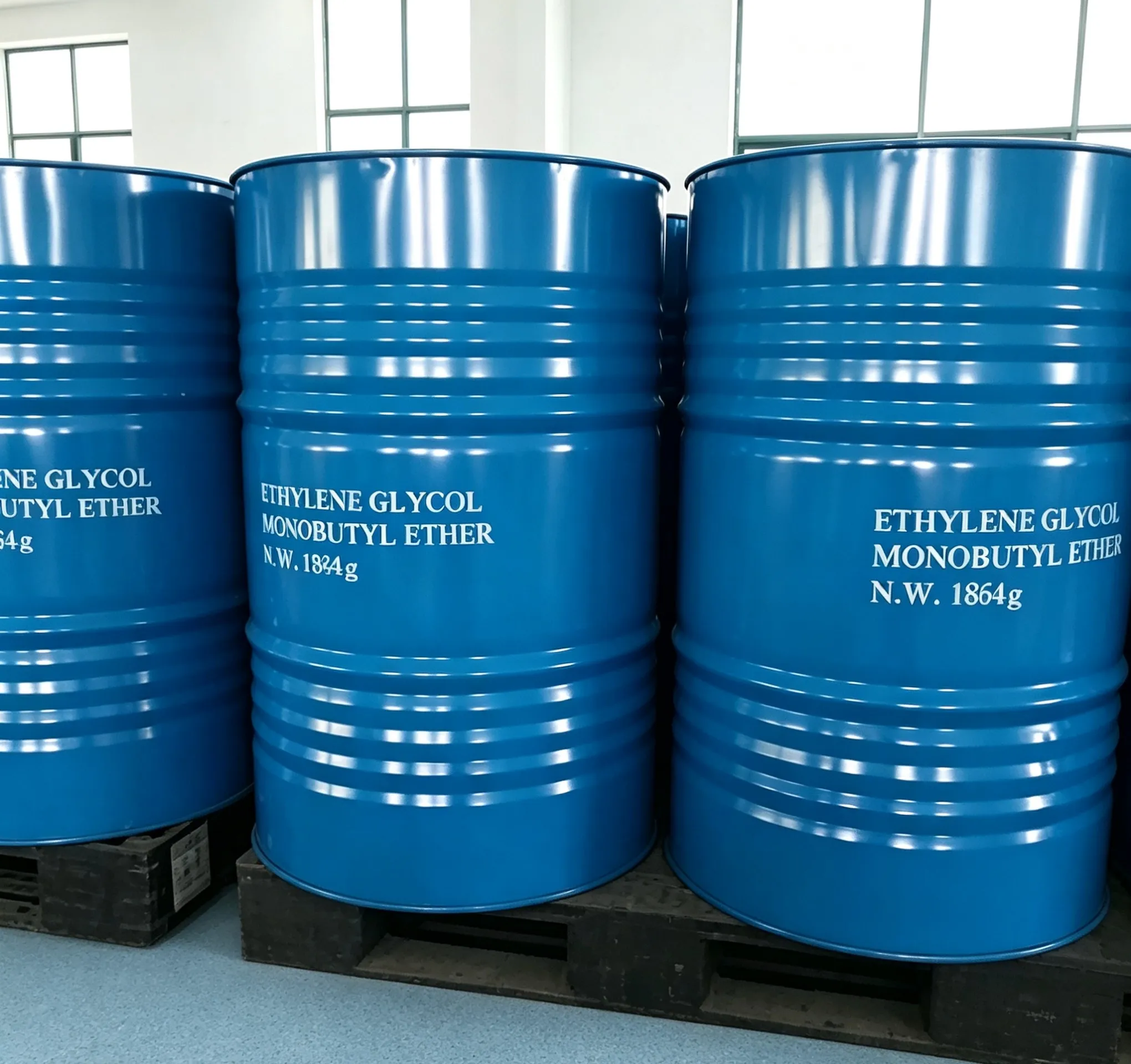
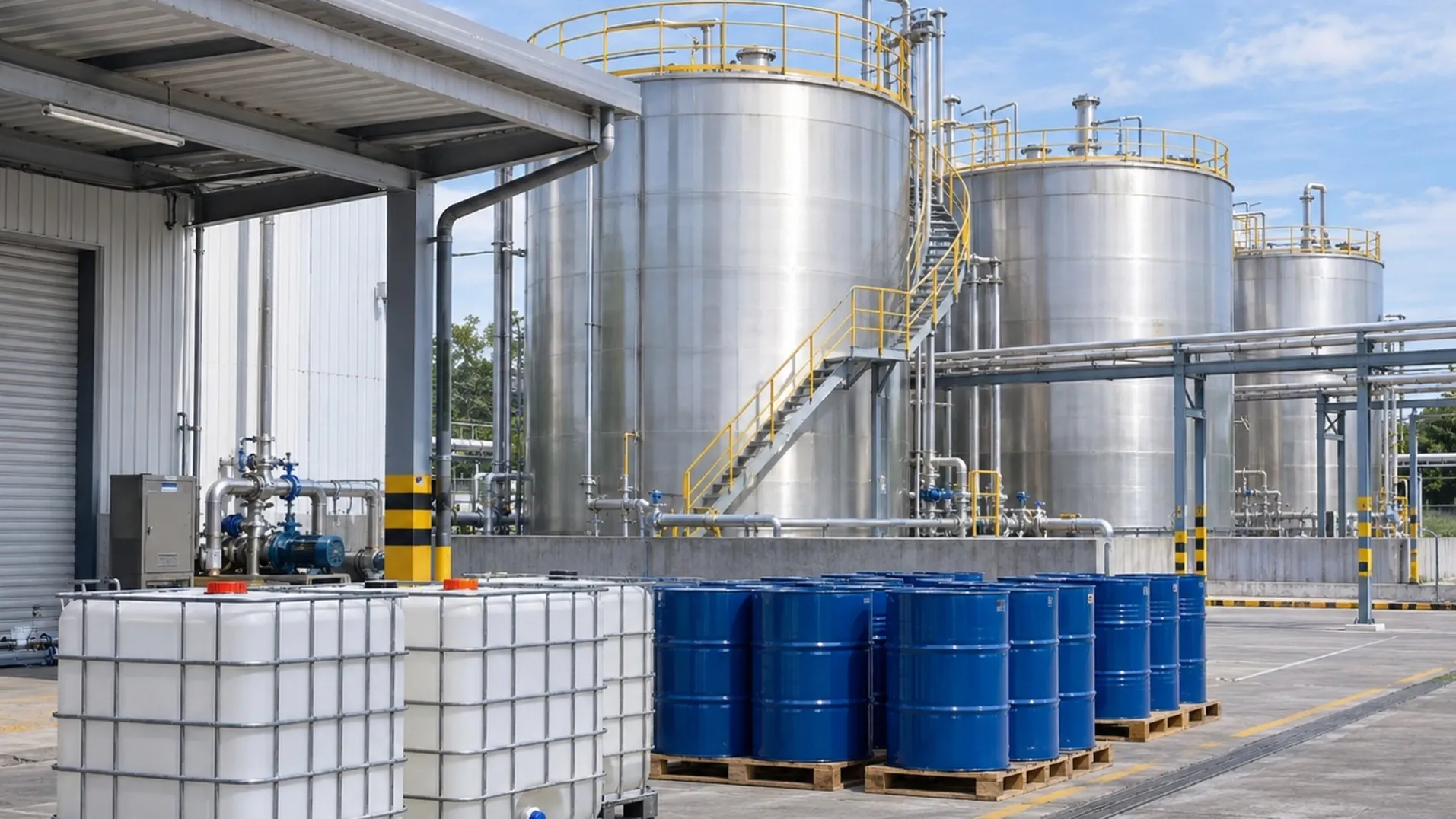
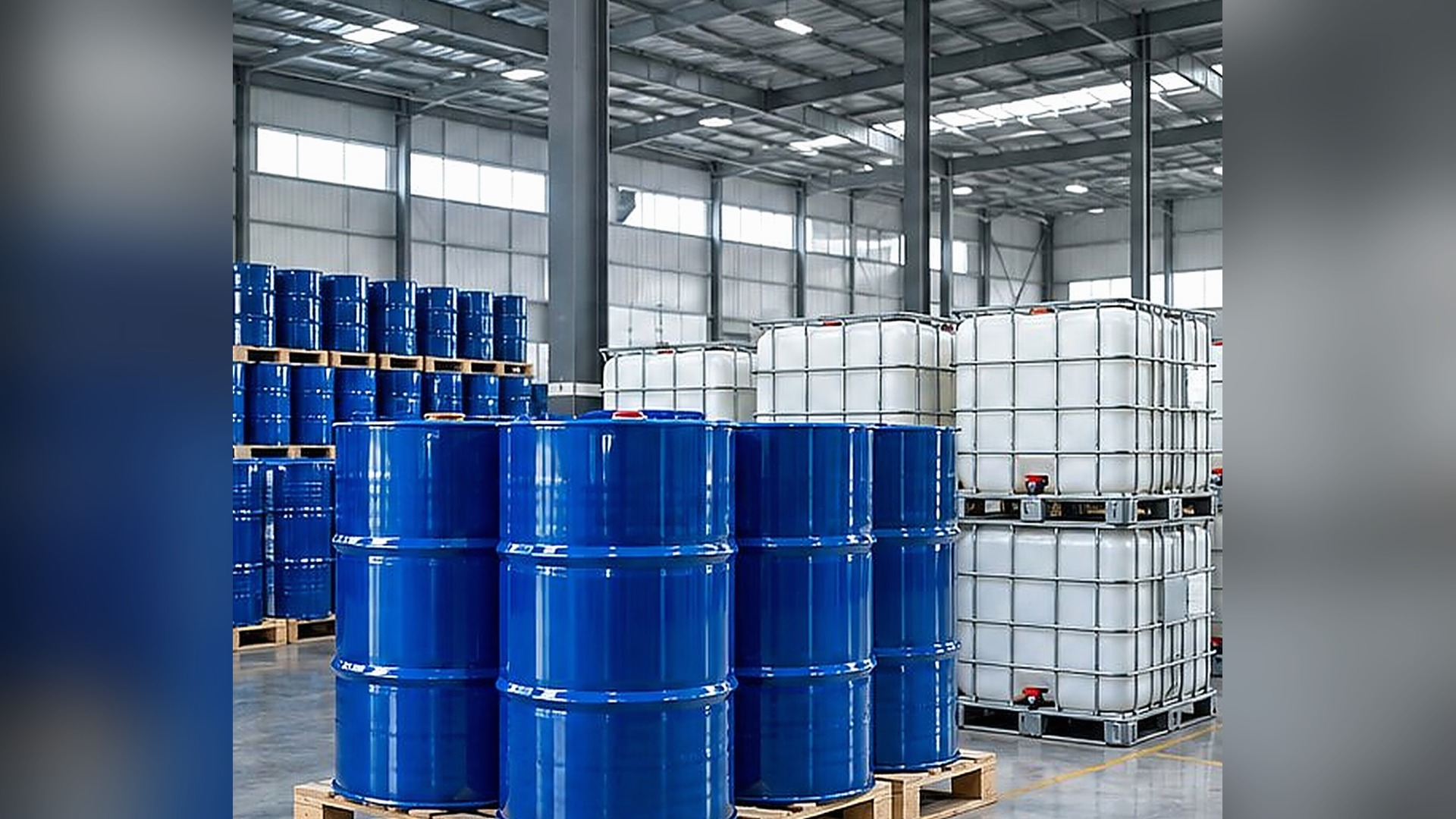
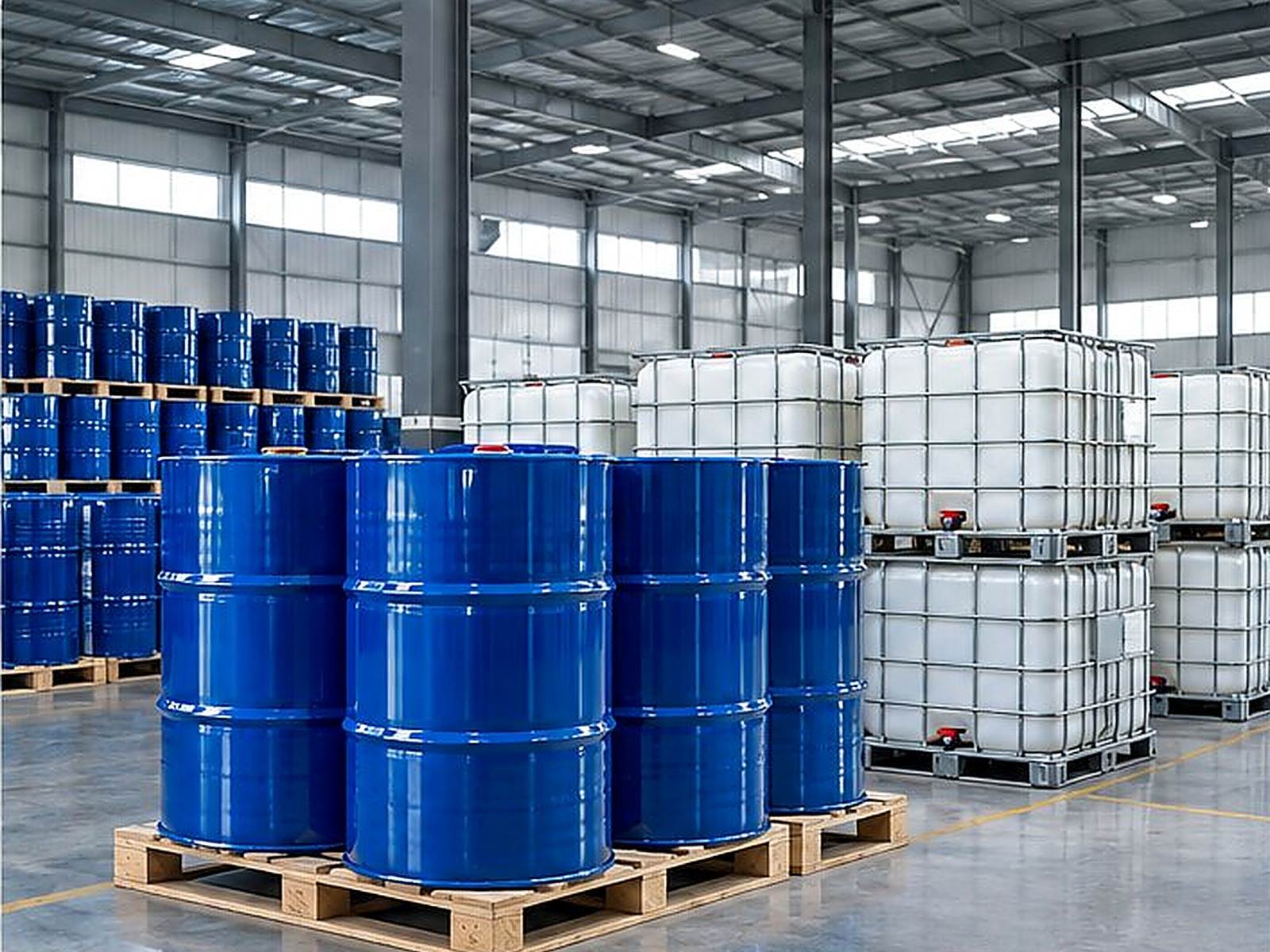
What Yuandafeng supplies: industrial-grade tetrahydrofuran 99.99% (CAS 109-99-9) in 180 kg drums, IBC totes and ISO tanks, with per-batch COA, SDS and TDS available on request, a three-step quality control process, and FCL/LCL supply with samples available to evaluate quality first. THF ships as a dangerous good, UN 2056, Class 3, Packing Group II, in UN-standard packaging with compliant dangerous-goods documentation. Confirm the stabilisation status (BHT or unstabilised) and the shelf life for your batch on the COA/SDS when you order. For the buying side — grades, specifications and ordering — see our THF Buyer’s Guide.
FAQ
What peroxide level is safe in THF?
Below 25 ppm is generally safe, 25–50 ppm is moderate, 50–100 ppm is high, and above 100 ppm is hazardous — dispose of it through a licensed handler rather than using it. Test opened containers every 3 months, and always test before distilling or evaporating.
How long does an unopened drum of THF last?
Typically 12–24 months from manufacture, depending on the manufacturer — some give 12 months, others 24, one gives 30. The binding date is the expiry date on your batch SDS/COA, not a general rule.
Can I still use THF after its expiry date?
Only if it tests below the safe peroxide limit. Test it first; if the result is above 100 ppm, or if you cannot test it, dispose of it through a licensed handler. Never use expired THF on the assumption that it is fine.
Does BHT-stabilised THF ever form peroxides?
Yes. BHT is consumed as it works, especially in opened containers exposed to air and light, so stabilised THF still forms peroxides over time. That is why the 3-month testing routine applies to stabilised THF as well.
Can I remove peroxides from THF myself?
Peroxide removal (for example by alumina column treatment or reductive decomposition with ferrous sulfate) is a job for trained personnel with the right equipment. Never attempt to distil peroxide-contaminated THF, and never distil any THF to dryness. If you are unsure, dispose of it through a licensed handler.
What should I do if I see crystals in a THF container?
Do not open, move, shake or warm it. Crystals may be shock-sensitive peroxide. Keep the container away from heat and shock, mark it, and call your EHS team or a licensed disposal contractor immediately.
Methodology
Property and hazard data are from ICSC 0578 (Tetrahydrofuran, ILO/IPCS, November 2019): boiling point 66 °C, flash point −14.5 °C closed cup, vapour pressure 19.3 kPa at 20 °C, UN 2056, Class 3, Packing Group II. Peroxide chemistry, BHT stabiliser levels, shelf-life ranges and testing procedures are from the three BenchChem technical guides (THF in HPLC; BHT-stabilised THF safety; THF disposal) and the PatSnap THF chemical-compatibility review, which reports peroxide growth from 0.01–0.05 wt% in freshly distilled THF to above 1.0 wt% within 2–4 weeks under ambient conditions. Shelf-life figures are presented as ranges because manufacturer guidance differs; the KI colour scale (colourless <10 ppm, pale yellow 10–50 ppm, brown >50 ppm) is from the BenchChem BHT-stabilised THF safety guide. YDFChem product data are from the verified product page (https://www.ydfchem.com/products/thf).
Limitations
Manufacturer shelf-life guidance varies (12, 24 and 30 months are all published for unopened containers), and BHT concentrations vary across sources (100–400 ppm, typically 250–400 ppm); the ranges in this article reflect that spread, and the expiry date on your batch documents governs. Peroxide bands (below 25 ppm safe, 25–50 ppm moderate, 50–100 ppm high, above 100 ppm hazardous; 0.1 wt% distillation limit) are general guidance from the cited sources, not a substitute for your batch SDS or local regulations. Whether Yuandafeng’s THF is BHT-stabilised was not confirmed in the sources used — confirm it on the batch COA/SDS. This article is general safety information for industrial buyers; it does not replace the product SDS, your site’s safety procedures, or local hazardous-waste rules.
References
- ICSC 0578 — Tetrahydrofuran (ILO/IPCS, November 2019): https://chemicalsafety.ilo.org/dyn/icsc/showcard.display?p_card_id=0578&p_version=1&p_lang=en
- BenchChem — Navigating Tetrahydrofuran (THF) in HPLC: A Technical Support Guide: https://pdf.benchchem.com/95/Navigating_Tetrahydrofuran_THF_in_HPLC_A_Technical_Support_Guide.pdf
- BenchChem — In-Depth Technical Guide to Safety Precautions for Handling and Storing BHT-Stabilized Tetrahydrofuran: https://pdf.benchchem.com/579/In_Depth_Technical_Guide_to_Safety_Precautions_for_Handling_and_Storing_BHT_Stabilized_Tetrahydrofuran.pdf
- BenchChem — Proper Disposal of Tetrahydrofuran (THF): A Guide for Laboratory Professionals: https://pdf.benchchem.com/95/Proper_Disposal_of_Tetrahydrofuran_THF_A_Guide_for_Laboratory_Professionals.pdf
- PatSnap — Tetrahydrofuran Chemical Compatibility: Comprehensive Analysis of Stability, Reactivity, and Material Interactions: https://eureka.patsnap.com/materials/thf-chemical-compatibility
- BenchChem — Tetrahydrofuran (Stabilized), product page (BHT stabiliser and shelf-life data): https://www.benchchem.com/product/b579089