Oct 29, 2026Buying Guides
Methyl Acetate vs Ethyl & Butyl Acetate: Real Data Comparison
Compare methyl acetate, ethyl acetate and n-butyl acetate using published 20°C vapor-pressure, solubility and boiling-point data plus NIST calculations.
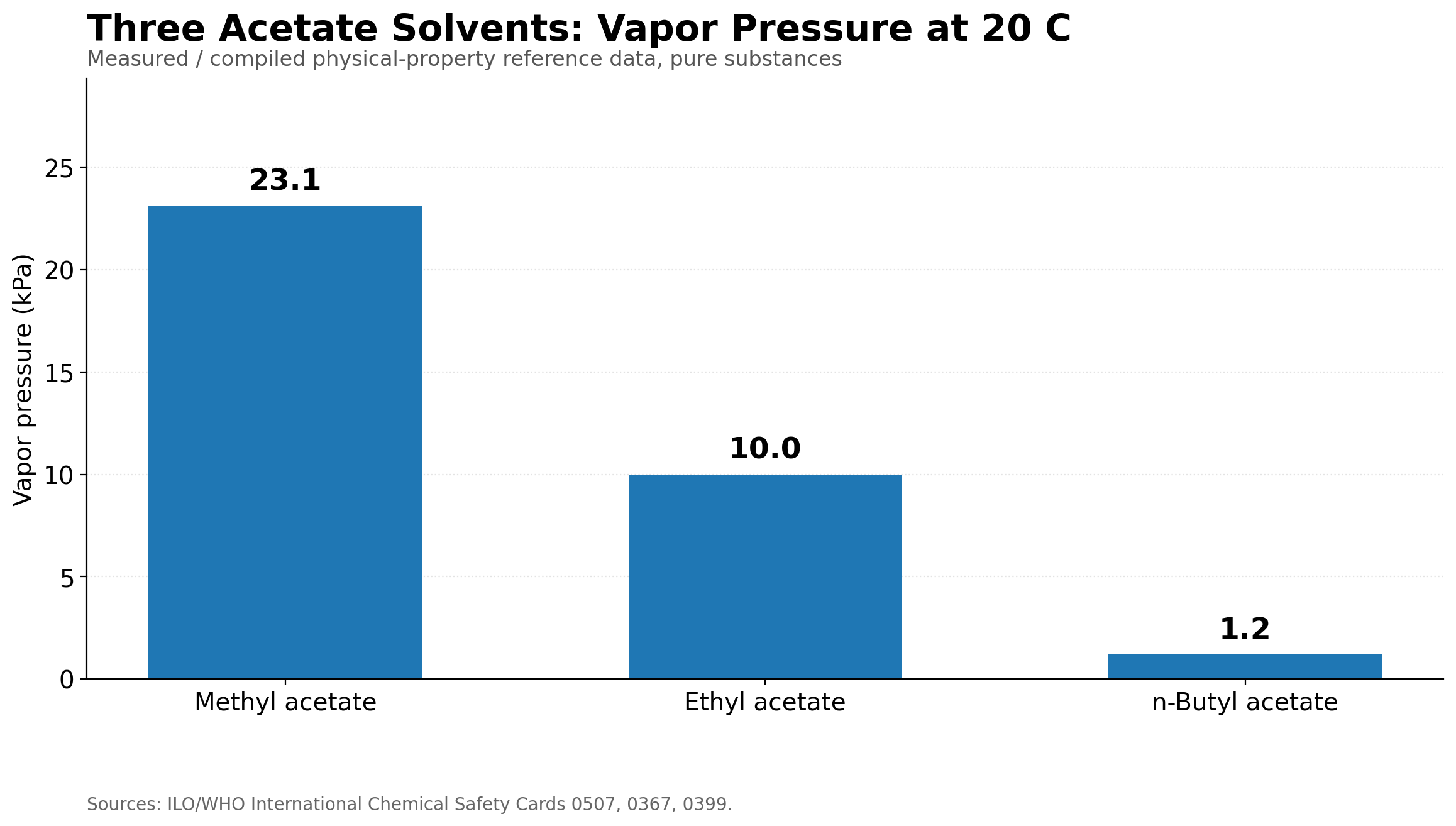
With n-butyl acetate as a third reference solvent, plus temperature-dependent calculations from published NIST data.
Research type: reference-data benchmarking and reproducible equation-based calculations. Primary sources: ILO/WHO International Chemical Safety Cards; NIST Chemistry WebBook SRD 69. Published by YUANDAFENG CHEMICAL · October 29, 2026. These are published measurements/reference values and new calculations from existing NIST correlations, not original evaporation experiments performed by YDF.
Key findings
At 20°C, the ILO/WHO reference vapor pressures are 23.1 kPa for methyl acetate, 10 kPa for ethyl acetate and 1.2 kPa for n-butyl acetate [1–3].
Methyl acetate's 20°C reference vapor pressure is about 2.3 times ethyl acetate's and 19.3 times n-butyl acetate's. This is not an experimentally measured drying-rate ratio.
The same chemical safety cards report approximate boiling points of 57°C, 77°C and 126°C, respectively [1–3].
Using NIST-published Antoine correlations, methyl acetate's calculated saturated vapor pressure rises from 22.97 kPa at 20°C to 54.07 kPa at 40°C, compared with 9.84 to 25.06 kPa for ethyl acetate [4–5].
Solvent replacement still requires testing in the actual formulation; volatility and solubility alone do not establish coating performance or material compatibility.
1. Why industrial buyers compare acetate solvents
Methyl acetate (CAS 79-20-9) (methyl acetate product page), ethyl acetate (CAS 141-78-6) and n-butyl acetate (CAS 123-86-4) are familiar ester solvents, used in different industrial formulations and processes. The three chemicals differ in volatility, water solubility and material interactions [1–3].
For a buyer evaluating coatings, inks, adhesives or cleaning applications, the right question is not simply “Which solvent is stronger?” A better screening question is: What differences can be demonstrated by comparable reference data, and what still needs a formulation test?
2. Benchmark 1: Vapor pressure, boiling point and water solubility
Table 1 — Published reference properties
Methyl acetate — CAS 79-20-9 · C3H6O2 · bp ≈57°C · vapor pressure 20°C 23.1 kPa · water solubility 20°C 24.4 g/100 mL
Ethyl acetate — CAS 141-78-6 · C4H8O2 · bp ≈77°C · vapor pressure 20°C 10 kPa · water solubility 20°C 8.7 g/100 mL
n-Butyl acetate — CAS 123-86-4 · C6H12O2 · bp ≈126°C · vapor pressure 20°C 1.2 kPa · water solubility 20°C 0.7 g/100 mL
Source note: ILO/WHO International Chemical Safety Cards 0507, 0367, 0399 [1–3]. Values are published reference properties for individual pure substances, not a joint laboratory trial.
Methyl acetate shows the highest 20°C vapor pressure of the three acetate solvents. A more volatile pure chemical can have greater potential for vapor generation at a given temperature, but that does not automatically predict drying time in an ink, coating or adhesive blend.
Water behavior matters too. At 20°C, methyl acetate is more soluble in water than ethyl acetate or n-butyl acetate according to these references. This may affect how formulations or work streams respond to water; it does not mean methyl acetate is fully miscible with water or compatible with every system.
3. Benchmark 2: What happens between 20°C and 40°C?
Instead of extrapolating from a single boiling point, we independently recalculated saturated vapor pressure using the original Antoine-equation coefficients published by NIST for methyl acetate and ethyl acetate [4–5].
Table 2 — Saturated vapor pressure calculated from NIST correlations
Temperature · Methyl acetate · Ethyl acetate
20°C — 22.97 kPa · 9.84 kPa
30°C — 35.85 kPa · 16.01 kPa
40°C — 54.07 kPa · 25.06 kPa
Source note: computed from Antoine correlations within their cited validity ranges; values rounded to two decimal places.
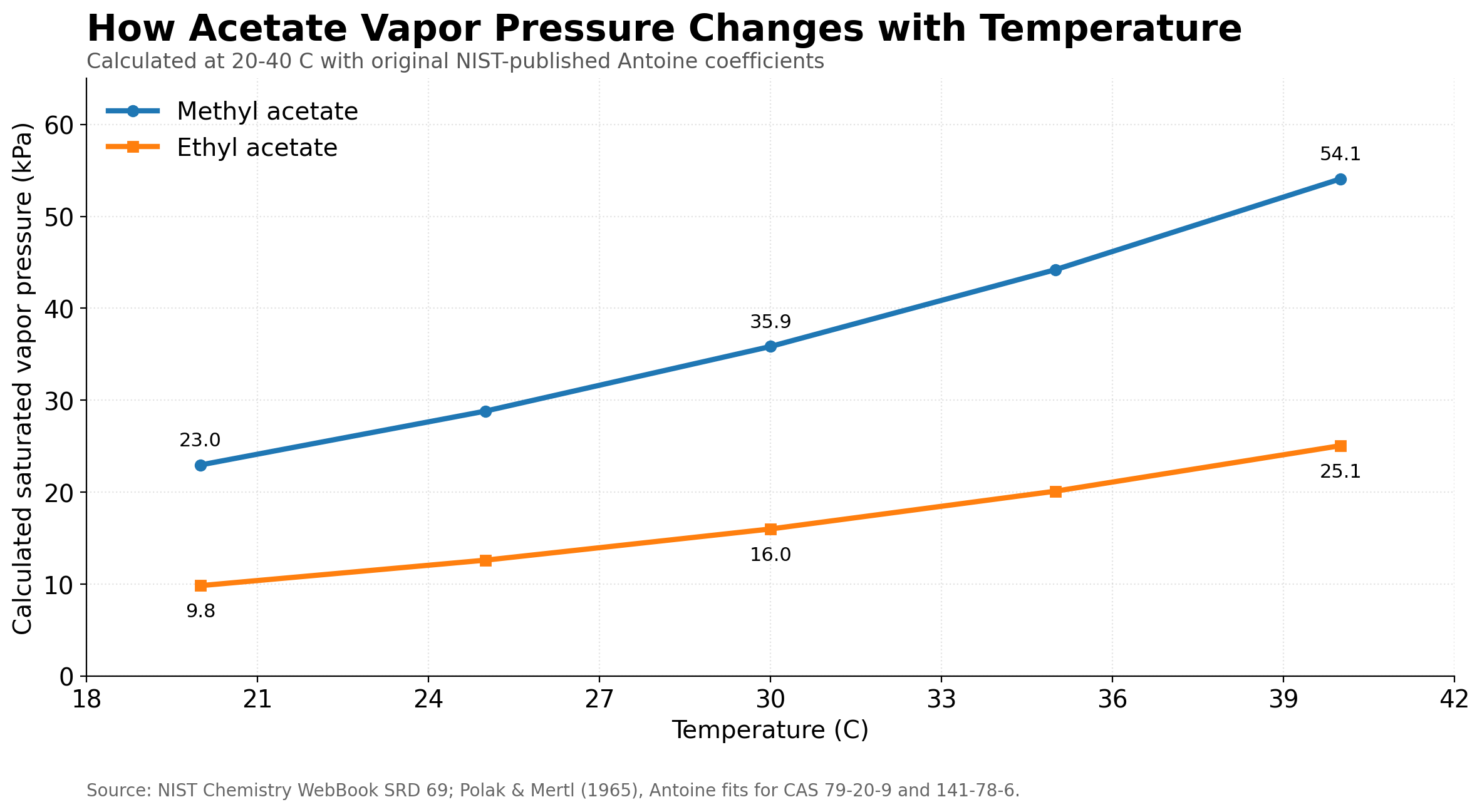
Both acetate solvents show rising equilibrium vapor pressure as temperature increases. At 40°C, the calculated methyl acetate value is approximately 2.16 times the ethyl acetate value.
The equation and reproducible inputs
NIST provides an Antoine equation in which pressure is in bar and temperature in Kelvin:
log10(P) = A − B / (T + C)
We converted pressure from bar to kPa by multiplying by 100 and used T(K) = T(°C) + 273.15.
Methyl acetate — A 4.20364 · B 1164.426 · C −52.69 · NIST valid range 274.91–328.99 K
Ethyl acetate — A 4.22809 · B 1245.702 · C −55.189 · NIST valid range 288.73–348.98 K
The calculations at 20°C, 30°C and 40°C are inside both stated valid ranges. NIST attributes the source measurements to Polák and Mertl (1965) [4–5]. Because no same-range Antoine correlation for n-butyl acetate was used, we do not present an invented n-butyl acetate temperature curve.
4. Does this mean methyl acetate is always the better fast-drying solvent?
No. The physical-property results show a volatility difference; they do not substitute for a coating or printing test.
Eastman describes methyl acetate as a fast-evaporating solvent used in coatings and inks, and Celanese lists applications including fast-dry coatings, adhesives and chemical intermediates [6–7]. These manufacturer statements demonstrate possible uses, not independently verified performance of every supplier grade.
In an actual process, drying time and surface quality can also depend on resin chemistry, solvent blend composition, film thickness, airflow, ambient humidity, substrate and drying temperature.
A procurement comparison should check at least solvency, purity, methanol content where relevant, moisture, acidity, material compatibility and process performance. In moisture-sensitive systems, the required grade may matter more than a generic boiling-point ranking [6–7].
5. Transportation and sourcing considerations
The ILO/WHO card identifies methyl acetate as UN 1231, Class 3, Packing Group II [1], consistent with the IMO dangerous-goods listing [8]. The exact documentation and packaging for a shipment must be determined using the current applicable transport regulations and the specific product SDS.
Required assay and permitted impurities — Grades from different suppliers are not always equivalent
Moisture, acidity and alcohol content — Can affect moisture-sensitive processes and finished quality
COA / SDS / technical specifications — Supports technical approval and safe handling
Actual packaging availability — Packaging must match chemical compatibility, shipment size and transport rules
Quantity, destination and Incoterms — Enables a useful and realistic export quotation
Do not assume a purity, package type or transport solution is available from YDF until confirmed against the current supply quotation and product documentation.
6. Frequently asked questions
Is methyl acetate more volatile than ethyl acetate?
According to the reference values compared here, yes: 23.1 versus 10 kPa saturated vapor pressure at 20°C [1–2]. Actual drying behavior in a formulated product requires additional testing.
What is methyl acetate's boiling point?
The ILO/WHO International Chemical Safety Card gives approximately 57°C [1]. Supplier-specific technical sheets may state a normal boiling range.
Can methyl acetate replace ethyl acetate in coatings or inks?
Sometimes it may be an option, but it is not a universal drop-in replacement. Check resin compatibility, viscosity, evaporation profile, impurity limits, worker exposure and finished-product performance under actual process conditions.
Is methyl acetate dangerous goods for shipment?
The referenced transport classification is UN 1231, Class 3, Packing Group II [1,8]. Confirm current shipping requirements and documents for the specific route and grade.
7. Methodology, sources and limitations
This article combines the ILO/WHO International Chemical Safety Cards for three pure esters (common reference temperature of 20°C) with an original re-calculation of NIST's published Antoine fits for methyl acetate and ethyl acetate [1–5]. Manufacturer pages from Eastman and Celanese were consulted only to document real industrial application examples, not to claim YDF has performed or passed a formulation trial [6–7].
Research limitations
This is a published-data comparison and equation-based analysis, not an in-house laboratory experiment, controlled evaporation-rate measurement or grade approval. Values for mixed-solvent formulations can differ from pure-component data. Regulatory statements, including US-specific VOC treatment of a particular commercial methyl acetate grade, must not be generalized to other products or countries.
Conclusion
Methyl acetate has a substantially higher saturated vapor pressure at 20°C than ethyl acetate and n-butyl acetate according to published reference values. The independent NIST calculation also shows a clear vapor-pressure increase between 20°C and 40°C.
For industrial buyers, these values can narrow a solvent shortlist, but the final choice still requires confirmation of grade, impurities, application performance, safety documentation and transportation conditions.
Looking for methyl acetate (CAS 79-20-9) from China?
Share your target purity, specification, quantity, packaging and destination with YUANDAFENG CHEMICAL for a product-specific sourcing and export quotation.
Related reading
References
Data attribution: ILO/WHO ICSC and NIST Chemistry WebBook (SRD 69). This article contains original calculations based on previously published reference values and correlations.