Oct 29, 2026Buying Guides
MTBE vs ETBE vs Ethanol: Vapor Pressure & Oxygen Content Data
Compare MTBE, ETBE and ethanol using published 20°C vapor-pressure data, calculated oxygen content, and evidence-based handling considerations.
An evidence-based comparison for buyers of methyl tert-butyl ether (MTBE), gasoline oxygenates and bulk industrial chemicals.
Research type: published-data comparison and reproducible molecular-weight calculation. Data sources: ILO/WHO International Chemical Safety Cards (ICSC), US EPA and US Geological Survey (USGS). Published by YUANDAFENG CHEMICAL · October 29, 2026. This is an independent analysis of published reference data, not a new laboratory experiment or fuel-blending trial conducted by YDF.
Key findings
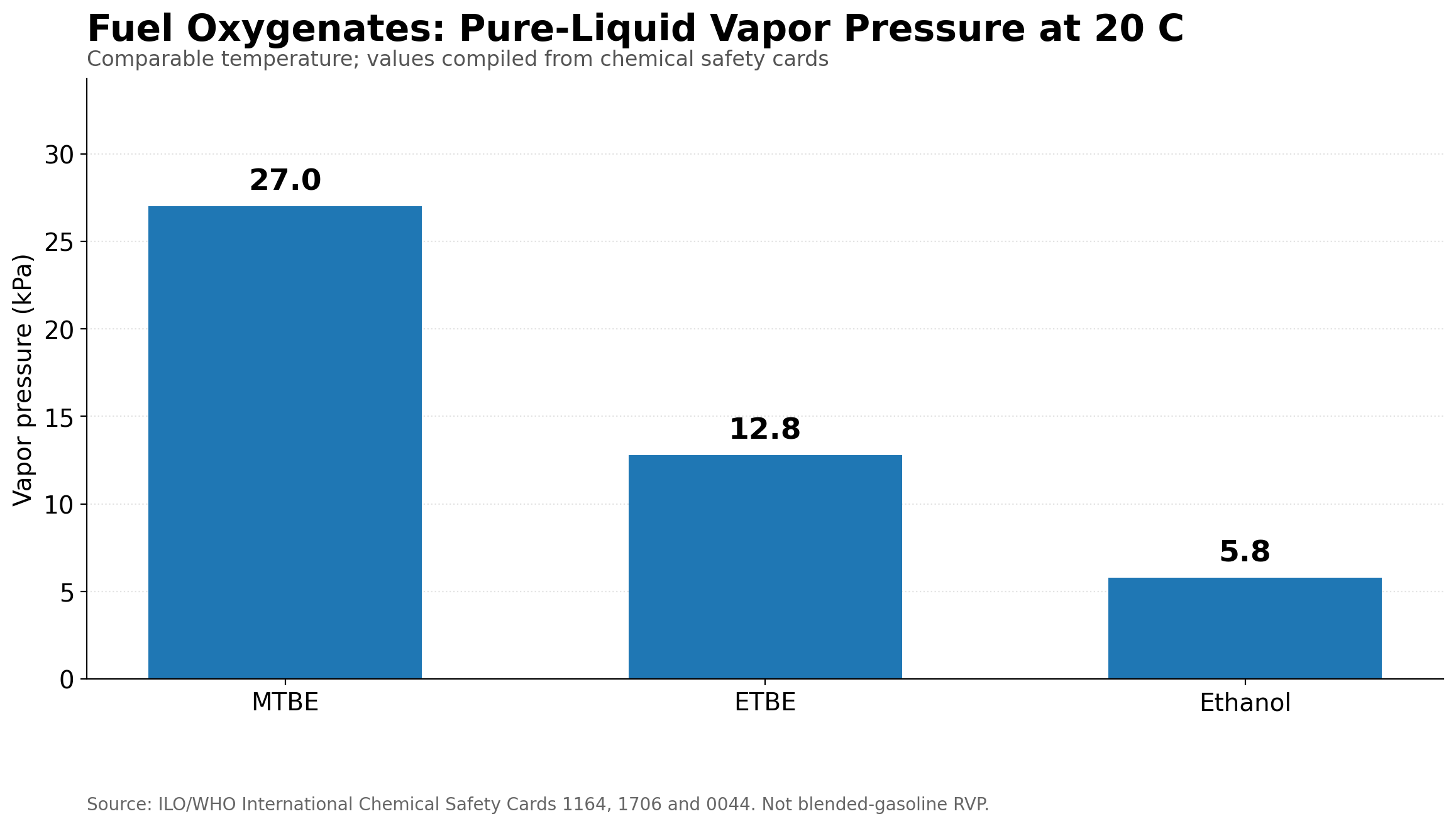
MTBE has a reported saturated vapor pressure of 27 kPa at 20°C, compared with 12.8 kPa for ETBE and 5.8 kPa for ethanol. The MTBE value is approximately 2.1 times ETBE's at the same temperature [1–3].
Molecular formulas imply an oxygen mass fraction of approximately 18.15% for MTBE, 15.66% for ETBE and 34.73% for ethanol. These are theoretical pure-chemical values, not gasoline-blend oxygen contents.
Higher oxygen mass percentage does not prove better octane performance, lower total emissions or regulatory suitability. Those outcomes require formulation, engine and destination-market evaluation.
MTBE's handling and environmental characteristics require attention. The US EPA identifies historical groundwater concerns, and the ICSC lists MTBE as UN 2398, Class 3, Packing Group II [1,4–5].
1. Why compare MTBE with ETBE and ethanol?
Methyl tert-butyl ether (MTBE; CAS 1634-04-4) (MTBE product page) is an ether used historically as an oxygen-containing gasoline blending component and octane enhancer. Ethyl tert-butyl ether (ETBE; CAS 637-92-3) and ethanol (CAS 64-17-5) also contain oxygen, but they differ in molecular structure, volatility, water behavior and regulatory context [1–4].
Buyers often ask whether one oxygenate can replace another. Answering that question with a simple “yes” or “no” would be misleading. A sensible initial comparison separates measurable pure-liquid properties from performance in a gasoline formulation.
2. What do the reported 20°C vapor-pressure values show?
Table 1 — Reference physical-property comparison
MTBE — CAS 1634-04-4 · C5H12O · bp ≈55°C · vapor pressure 20°C 27 kPa · oxygen 18.15%
ETBE — CAS 637-92-3 · C6H14O · bp ≈70–73°C · vapor pressure 20°C 12.8 kPa · oxygen 15.66%
Ethanol (anhydrous) — CAS 64-17-5 · C2H6O · bp ≈78°C · vapor pressure 20°C 5.8 kPa · oxygen 34.73%
Source note: 20°C vapor pressures and boiling points: ILO/WHO ICSC 1164, 1706 and 0044 [1–3]. Oxygen values: author calculations from standard elemental atomic masses and the listed molecular formulas. Published ICSC figures are compiled reference values and do not represent three substances tested together in the same apparatus.
At the same reference temperature, the MTBE vapor-pressure figure is approximately 2.1 times ETBE's and 4.7 times ethanol's. This difference is relevant to vapor management and storage design. It does not mean MTBE-containing gasoline has 2.1 times the Reid vapor pressure of ETBE-containing gasoline; blend behavior is not determined by comparing pure-component vapor pressures alone.
3. How much oxygen does each pure chemical contain?
We calculated oxygen percentage using each molecule's chemical formula:
Oxygen mass fraction (%) = 15.999 / molecular mass × 100
For example, MTBE has a calculated molecular mass of 88.15 g/mol and contains one oxygen atom: 15.999 / 88.15 × 100 = 18.15%.
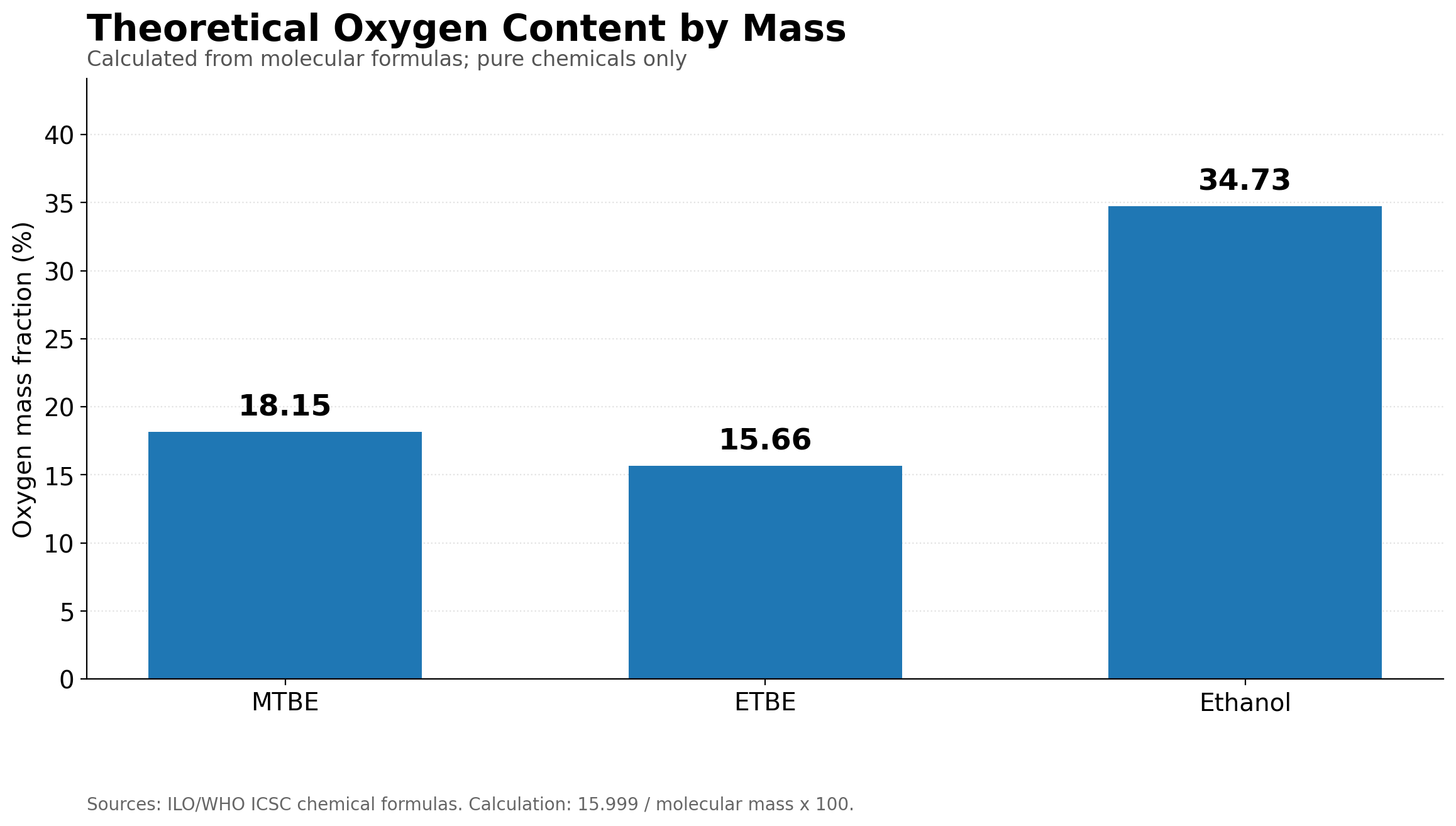
Ethanol has the highest theoretical oxygen fraction by mass among these three pure components. This ranking is not a ranking of fuel performance. Commercial blending decisions also depend on specifications, blending limits, compatibility, economics and laws in the destination market.
4. What do real-world environmental studies add?
The US EPA explains that fuel oxygenates were used in reformulated gasoline and other fuel grades, while noting that MTBE use in gasoline sold in the United States has virtually ceased [4]. This US-specific history should not be presented as a global prohibition or as proof of present demand in other countries.
A USGS fact sheet reports an illustrative comparison: when gasoline containing 10% MTBE by weight comes in contact with water, its calculated/estimated MTBE solubility contribution at 25°C is approximately 5,000 mg/L, whereas the total hydrocarbon solubility cited for a non-oxygenated gasoline is typically around 120 mg/L [5]. These represent different substances and mixtures, not a head-to-head controlled toxicity test; they illustrate why groundwater contamination and spill prevention merit particular attention.
For an industrial buyer, the practical message is to check the receiving country's regulatory requirements and the intended use before committing to a shipment.
5. What should MTBE importers verify before requesting a quotation?
Which grade is available? Current batch COA, assay, water and impurity limits appropriate to the application
What documentation is supplied? Current SDS, specification sheet and required export or dangerous-goods paperwork
How is it packaged? Verified packaging availability and compatibility for the actual shipment
Where will it be used? Destination-country rules and application-specific restrictions
What are the delivery terms? Quantity, destination port, Incoterms and expected shipment schedule
The ICSC identifies MTBE as a highly flammable liquid under UN 2398, Class 3, Packing Group II [1]. The applicable transport rules and shipper requirements should be confirmed for the specific order. YDF does not publicly promise an unverified grade, packing format or delivery date.
6. Frequently asked questions
Is MTBE the same as ETBE?
No. Both are ethers used as fuel oxygenates, but MTBE (C5H12O) and ETBE (C6H14O) have different CAS numbers and physical properties.
Is MTBE more volatile than ETBE at 20°C?
The reference values compared here are 27 kPa for MTBE and 12.8 kPa for ETBE. This compares pure-liquid saturated vapor pressure, not measured gasoline evaporation or blending behavior.
Does higher oxygen content mean a better fuel additive?
Not by itself. Oxygen mass fraction is only one compositional metric. Octane performance, emissions, storage compatibility and regulations require separate evaluation.
Can MTBE be exported internationally?
Export possibilities must be assessed for the actual supplier, product, destination, use and dangerous-goods requirements. Requirements differ by jurisdiction; US fuel-use history is not a universal import/export rule.
7. Methodology and limitations
We used three publicly available ILO/WHO chemical safety cards to collect molecular formulas, approximate boiling points and saturated vapor-pressure values at 20°C [1–3]. Ratios were calculated directly from those reported values; theoretical oxygen mass fractions were calculated from molecular formulas using C = 12.011, H = 1.008 and O = 15.999 g/mol. Additional contextual evidence was taken from EPA and USGS publications [4–5].
Research limitations
The three vapor-pressure data points are compiled reference values, not a new common-apparatus trial. We did not measure Reid vapor pressure of blends, octane ratings, emissions, evaporation rates or fuel performance. Regulatory applicability varies by country. Published reference values are not a substitute for product-specific SDS/COA or a formulation trial.
Conclusion
MTBE, ETBE and ethanol differ meaningfully in pure-liquid vapor pressure and oxygen fraction by mass. Those differences are useful starting points for screening and handling discussions, but they cannot determine which oxygenate is best for a given gasoline formulation or destination market.
Need a quote for MTBE (CAS 1634-04-4)?
Contact YUANDAFENG CHEMICAL with your grade/specification, quantity, destination, packaging preference and intended application. Availability and shipment conditions are confirmed for each inquiry.
Related reading
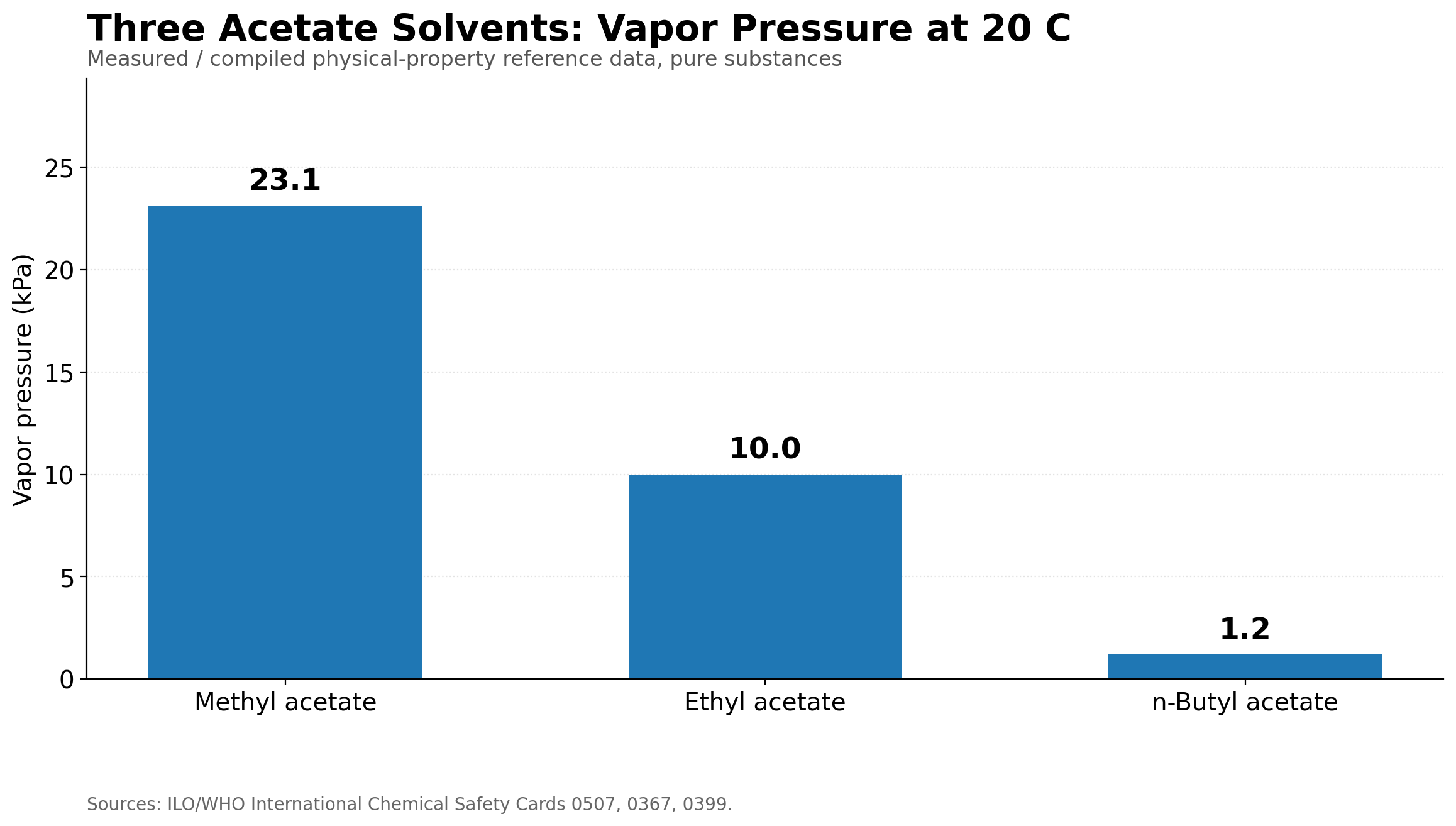
Comparing acetate solvents? See our published-data review: Ethyl acetate vs n-butyl acetate: what the data say.
References
US Geological Survey, Environmental Behavior and Fate of Methyl tert-Butyl Ether (Fact Sheet 203-96)
Data attribution: ILO/WHO ICSC, US EPA and USGS. This article contains original calculations based on previously published reference values.